The Jakarta Post
Please Update your browser
Your browser is out of date, and may not be compatible with our website. A list of the most popular web browsers can be found below.
Just click on the icons to get to the download page.


Popular Reads
Top Results
No results found. Please check your search term and try again
Can't find what you're looking for?
View all search results
Popular Reads
Top Results
No results found. Please check your search term and try again
Can't find what you're looking for?
View all search resultsInside Green Soldier's Most Ambitious Chapter Yet
Following a successful school recycling pilot and support from Semarang's mayor, Green Soldier is preparing to expand to five schools while developing agricultural projects and new ways to finance its operations.
Change text size
Gift Premium Articles
to Anyone
Share the best of The Jakarta Post with friends, family, or colleagues. As a subscriber, you can gift 3 to 5 articles each month that anyone can read—no subscription needed!
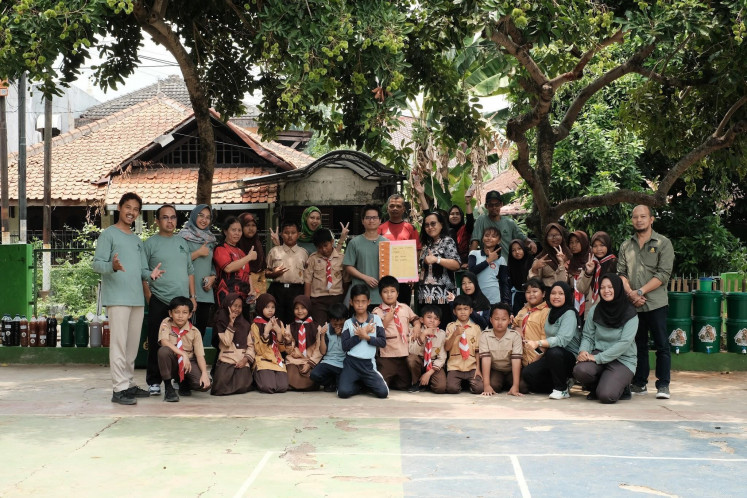
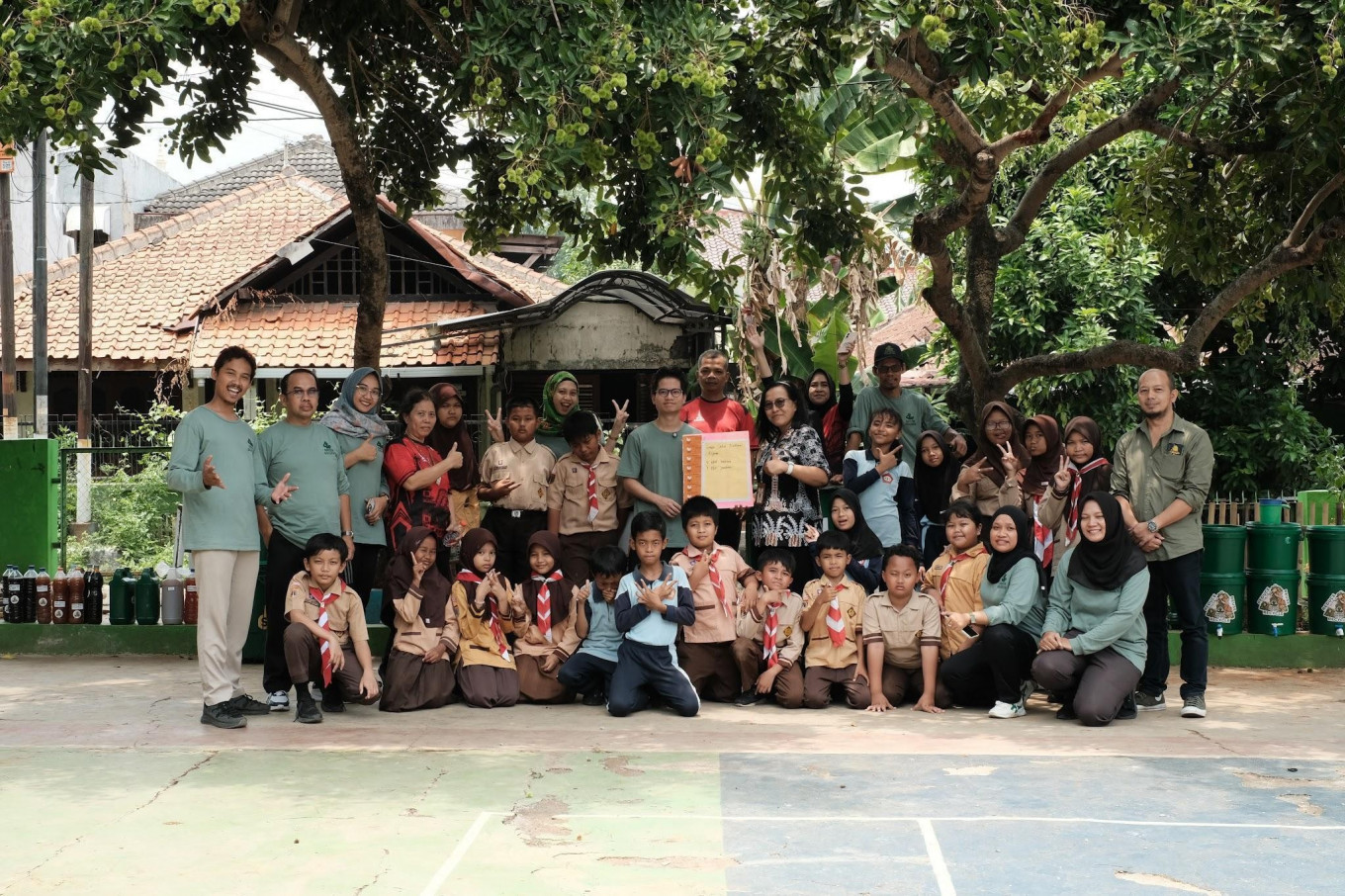 Green Soldier representatives and SDN Karangrejo 01 staff mark the formal handover of equipment and materials supporting the school's recycling and environmental programs in Semarang on Oct. 9, 2026.(Source: Green Soldier school community documentation, SDN Karangrejo 01)
A
t SDN Karangrejo 01 in Semarang, students can exchange recyclable waste for points recorded through a web application. Elsewhere on the school grounds, Green Soldier is developing fish ponds and vegetable-growing systems; the initiative is also selling agricultural products to help finance what it hopes to build at other schools.
The activities have expanded considerably from the plastic collection program that first brought Green Soldier public attention. Its digital waste bank allows students to deposit recyclable materials using individual QR codes. School operators record each deposit's weight and condition before crediting points to the student's account, while administrators can monitor collection records and participation. Green Soldier coordinates the subsequent collection and processing of materials through its own operations and manufacturing partners.
Following the success of its pilot at SDN Karangrejo 01, Green Soldier received support from Semarang Mayor Agustina Wilujeng Pramestuti for a planned expansion to five schools. The initiative also contributed to the environmental programs that helped SDN Karangrejo 01 earn the Adiwiyata Nasional award, Indonesia's second-highest level of environmental recognition for schools. Its recycling program and environmental education activities supported practices that students and teachers could maintain throughout the school year.

The school is now pursuing Adiwiyata Mandiri, the program's highest distinction. Green Soldier continues supporting this effort through its agricultural activities and school waste-management programs.
Can a school collect too much waste?
Christopher Dylan Suruadji, Green Soldier's founder and Project Lead, also leads its waste-processing research. As the initiative prepared to expand, he identified a potential problem: some schools could collect more organic waste than their equipment could process.
Consider two schools participating in Green Soldier's collection program. Suppose Green Soldier allocates equipment capable of processing 300 kilograms of organic waste per week to each location. During a particularly busy week, one school might collect 400 kilograms while the other collects only 200. Although the network has sufficient total processing capacity, an arrangement that prevents equipment from being shared would leave 100 kilograms untreated at the first location. Green Soldier could potentially avoid this shortage by redirecting excess material to available capacity elsewhere.
Christopher became interested in whether Green Soldier could avoid such shortages by combining localized processing equipment with shared facilities, particularly when purchasing enough capacity at every location to handle unpredictable increases in collection volumes could become expensive.
With guidance from Michel Lacerda, a doctoral researcher at the Georgia Institute of Technology, Christopher developed a mathematical model examining how different arrangements of processing facilities affect operating costs and the amount of organic waste left untreated.
Using a hypothetical eight-school network, he evaluated 231 possible capacity configurations using 50,000 training simulations and 100,000 independent validation simulations. The study compared localized processing facilities with one shared facility and arrangements combining both, accounting for fluctuations in collection volumes and equipment disruptions.
Under the study's assumptions, a hybrid configuration assigning 20 percent of nominal processing capacity to a shared facility and installing 25 percent additional reserve capacity left some waste untreated in approximately 2.35 percent of validation weeks. The findings reflect simulated conditions rather than measured outcomes at participating schools.
For Christopher, whose interest in mathematics has increasingly drawn him toward operations research and engineering, the study developed from decisions Green Soldier could eventually face when purchasing processing equipment. Its existing waste-bank records already provide information about recyclables collected at schools; he hopes to extend the research with detailed measurements of organic waste and processing expenses as the program grows.
Alongside his research, Christopher has been guiding Green Soldier's development of agricultural activities connecting organic waste processing with food production. These include black soldier fly larvae cultivation for potential fish-feed ingredients and composting suitable organic residues. The group is also developing fish-farming projects involving tilapia and gourami, alongside the cultivation of vegetables such as pakcoy and lettuce. Its broader agricultural work includes chili and tomatoes as well as corn and fruit cultivation involving grapes and durian.

What does a fish pond have to do with recycling?
Green Soldier's co-founder and Head of Engineering, Dohyoon Noh, focuses on the equipment and technology needed to support the initiative's activities.
One of the group's newer projects at SDN Karangrejo 01 involves an aquaponics installation based on Christopher's proposal to connect fish cultivation with vegetables grown in PVC channels. Dohyoon's engineering responsibilities involve helping develop the equipment required to operate the installation and examining how Green Soldier can maintain it as the program expands.
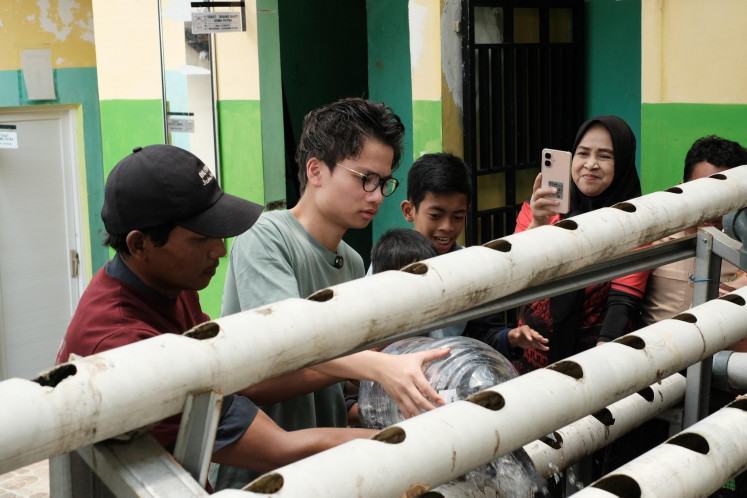
Water is intended to circulate from the fish pond through filtration before reaching the growing channels and returning to the pond. The process relies partly on beneficial bacteria that convert ammonia from fish waste into nitrite and subsequently nitrate, which plants can absorb.
Green Soldier has been assembling pipes and supporting structures while conducting seedling trials. Early interruptions in water circulation have highlighted the importance of reliable pumps and accessible filtration equipment.
The agricultural equipment also includes composting facilities intended to help students learn how organic scraps decompose. A separate motor-powered shredder uses rotating blades inside a cylindrical chamber to cut vegetable trimmings into smaller pieces before composting.
Another installation uses a metal drum with attached piping to heat woody material with limited oxygen and produce char for potential agricultural use. Unlike the simpler composting activities, the motorized and heated equipment requires trained adult supervision. The group is also preparing liquid fertilizer from organic materials while examining Azolla and duckweed as potential feed ingredients.
Dohyoon's engineering responsibilities extend to Green Soldier's digital waste-bank web application, which can be introduced to other schools without developing a separate platform for each campus. Operators will still need training to record deposits accurately and manage student accounts. The group's developing online shop will also need to display current product availability and accept buyer feedback.
Meanwhile, Coby Pradhana, Green Soldier's co-founder and Head of Environmental Impact and Sustainability, focuses on documenting the environmental outcomes of its recycling activities.
Across Green Soldier's earlier recycling activities at four schools, the initiative collected more than 300 kilograms of recyclable materials. Working with manufacturing partner PT Raja Besi in Semarang, the team helped turn suitable discarded plastics into school furniture including chairs and tables as well as paving blocks. Co-founder Ezra Ginesky coordinated business and logistics for the earlier recycling program, while Naren Louis handled public policy.
Coby has also contributed to developing Green Soldier's waste-bank web application, particularly its records of materials collected by participating students. The data allows the team to monitor collection totals and compare them with manufacturing results, helping distinguish between the weight of recyclables received and the quantities eventually transformed into usable products.
The same approach is becoming relevant to Green Soldier's newer agricultural activities. Recording how much organic material enters composting or insect cultivation and how much usable output each process produces will help determine which methods can be maintained at additional schools.
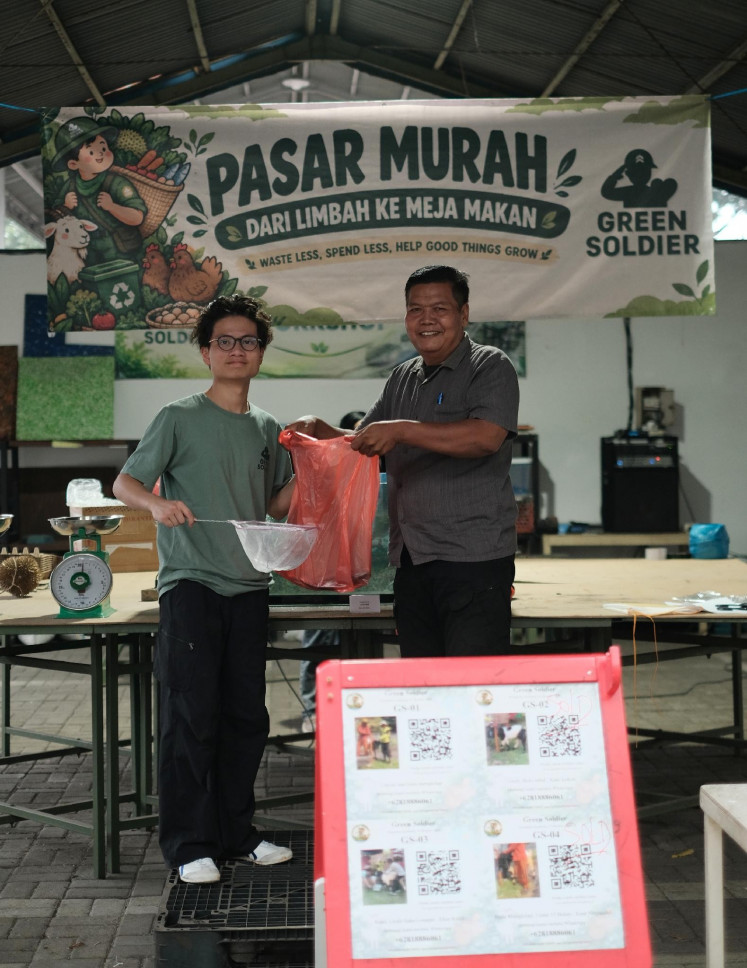
Available products will depend on what the group can harvest or supply. Customers will also be able to leave feedback after purchasing, helping Green Soldier understand which products are in demand and how future sales can be improved.
Fresh vegetables require suitable packaging and timely collection, while fruit availability may vary by season. The group must also account for production expenses before determining how much revenue can be returned to Green Soldier's activities.
The intention is to reinvest proceeds after expenses into the initiative's expansion. Sales of cultivated products and merchandise could help purchase growing materials for participating schools and contribute toward equipment such as water pumps and composting facilities, providing a source of funding alongside support from partners and local authorities.
Introducing the program to five schools will also require coordination with administrators and processing partners. Each participating school will need designated operators for its waste bank and a collection schedule suited to the materials it receives.
The team must consider which facilities each campus can accommodate. Schools with suitable growing areas may be able to cultivate vegetables or operate composting equipment, while those with limited space could participate through the digital waste bank and transfer collected materials to processing partners.
Green Soldier intends to use what it has learned at SDN Karangrejo 01 to guide these installations while training students and school staff to maintain the program between visits from the founding team.
At SDN Karangrejo 01, students' recyclable deposits can already be recorded through Green Soldier's digital waste bank. As Green Soldier prepares to work with five schools, its founders are now concentrating on what happens afterward: how the materials are processed and how the equipment will continue operating once the initial installation is complete.


More from The Weekender

Siapa Anda? Mengapa Anda?
What begins as a small grammatical curiosity becomes a larger question about language, culture and the way we understand ourselves in relation to others - and, ultimately, about what we risk losing in a world increasingly impatient with reflection, ambiguity and the humanities.

A passport to the kingdom of the sick
A breast cancer diagnosis, a journey to the kingdom of the sick and a determination to describe what lies there without metaphor, euphemism or the word “fight.”

The weight of time
Richard Mille’s newest ultralight timepiece pares down haute horlogerie to its mechanical necessities, proving that sophistication often comes from knowing what to leave out.