The Jakarta Post
Please Update your browser
Your browser is out of date, and may not be compatible with our website. A list of the most popular web browsers can be found below.
Just click on the icons to get to the download page.


Popular Reads
Top Results
No results found. Please check your search term and try again
Can't find what you're looking for?
View all search results
Popular Reads
Top Results
No results found. Please check your search term and try again
Can't find what you're looking for?
View all search resultsThe iconic wheels Jakarta left behind
Nearly a decade after a Jakarta governor suggested the return of becak, which has had a complicated relationship with the capital, electric versions are making a comeback elsewhere.
Change text size
Gift Premium Articles
to Anyone
Share the best of The Jakarta Post with friends, family, or colleagues. As a subscriber, you can gift 3 to 5 articles each month that anyone can read—no subscription needed!
 Set as preferred source
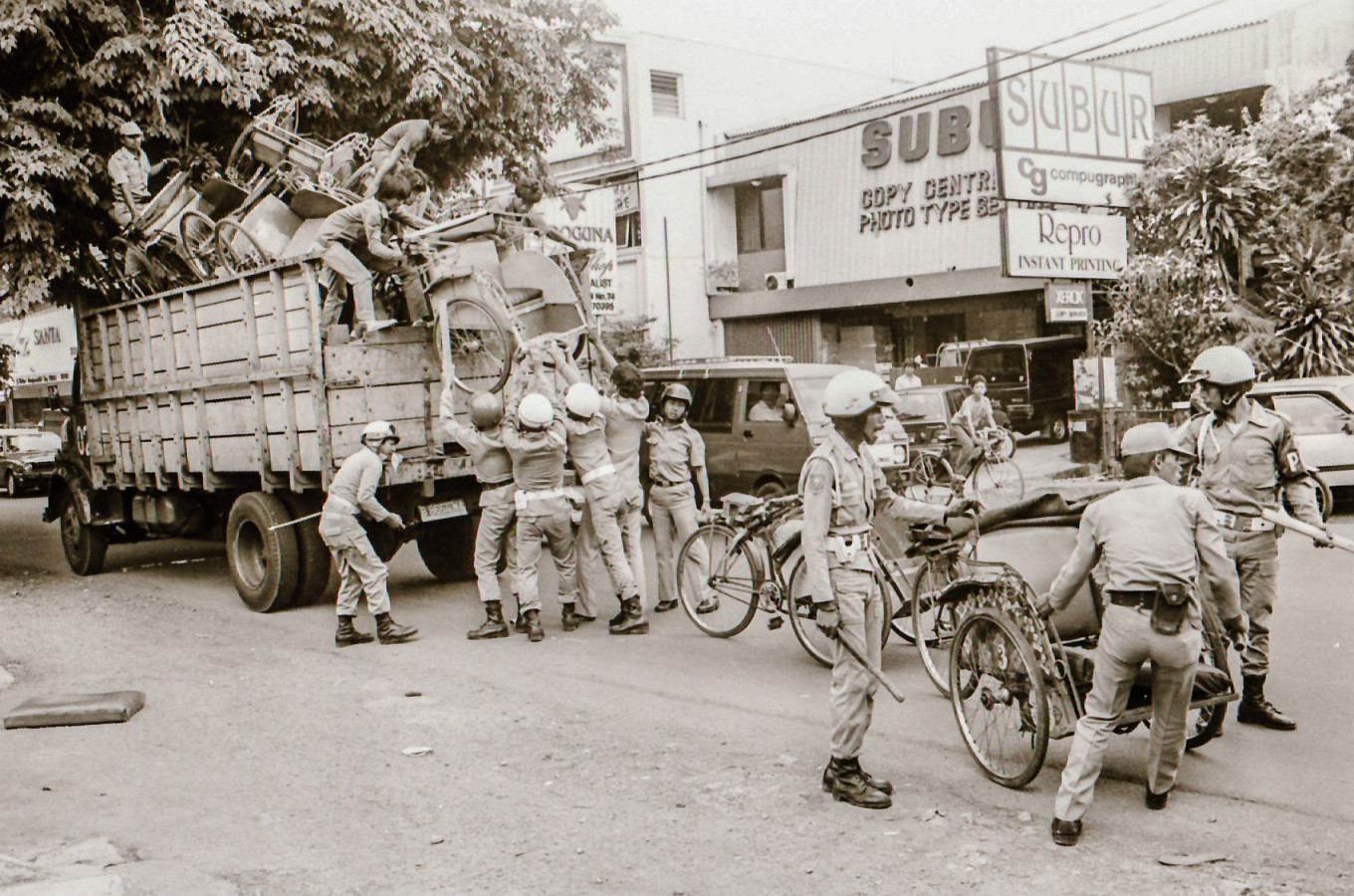 On Oct. 6, 1987, during a raid on Jl. Wolter Monginsidi in South Jakarta, officers seized and loaded pedicabs onto trucks as traffic whizzed by, seemingly oblivious to their removal. (The Jakarta Post Archive/Kosasih Derajat)
O
nce a familiar sight on Jakarta’s streets, becak (pedicab) has largely disappeared from the urban transportation landscape. Yet nearly a century after its arrival in the capital, the human-powered vehicle is getting a new lease on life elsewhere in the country, this time with an electric motor.
Becak began operating in Jakarta in 1936 and quickly became a major mode of public transport. By 1970, around 150,000 pedicabs were estimated to be operating in the capital, along with around 300,000 drivers working in two shifts, according to historical records cited by Antara.
This once ubiquitous three-wheelers were increasingly blamed for the city’s congestion and criticized as outdated for their reliance on human power. In 1970, governor Ali Sadikin banned the production of new becak and their entry to Jakarta.

The following year, the city restricted them from major roads, then a 1972 regulation classified becak alongside oplet, a type of public minivan, as forms of transport unsuitable for the capital.
The crackdown continued under successive administrations. The City Council passed a total ban in 1988 and in April 1990, the Jakarta administration moved to remove becak altogether. On Oct. 6, 1987, during a raid on Jl. Wolter Monginsidi in South Jakarta, officers seized and loaded pedicabs onto trucks as traffic whizzed by, seemingly oblivious to their removal.
During the 1997-1998 Asian financial crisis, governor Sutiyoso briefly relaxed the ban to help people affected by the economic downturn. Becak quickly returned to the city streets, but the reprieve lasted less than a week.
The issue resurfaced two decades later under governor Anies Baswedan, who proposed the revival of becak in 2018 as localized neighborhood transport, with special routes keeping them off major roads.


More from The Weekender

Questioning and nurturing the self with Abell Octovan
The visual artist explores new grounds and mediums in his first solo exhibition, Am I an Artist.

Radio still gives you something an algorithm can't
You can choose almost anything you want to hear these days. So why are young people still tuning in to radio?

Travels in the land of Gen Z (Part 2)
Beyond the fragility and short attention span, my students proved sharper, more open-minded and more generous than I’d expected. Second of two parts. Read the first here.