The Jakarta Post
Please Update your browser
Your browser is out of date, and may not be compatible with our website. A list of the most popular web browsers can be found below.
Just click on the icons to get to the download page.


Popular Reads
Top Results
No results found. Please check your search term and try again
Can't find what you're looking for?
View all search results
Popular Reads
Top Results
No results found. Please check your search term and try again
Can't find what you're looking for?
View all search resultsArt Moments 2026 rethinks the art fair experience
By prioritizing dialogue, discovery and curatorial cohesion over conventional booth structures, the Jakarta fair offered a fresh vision of what an art fair can be.
Change text size
Gift Premium Articles
to Anyone
Share the best of The Jakarta Post with friends, family, or colleagues. As a subscriber, you can gift 3 to 5 articles each month that anyone can read—no subscription needed!
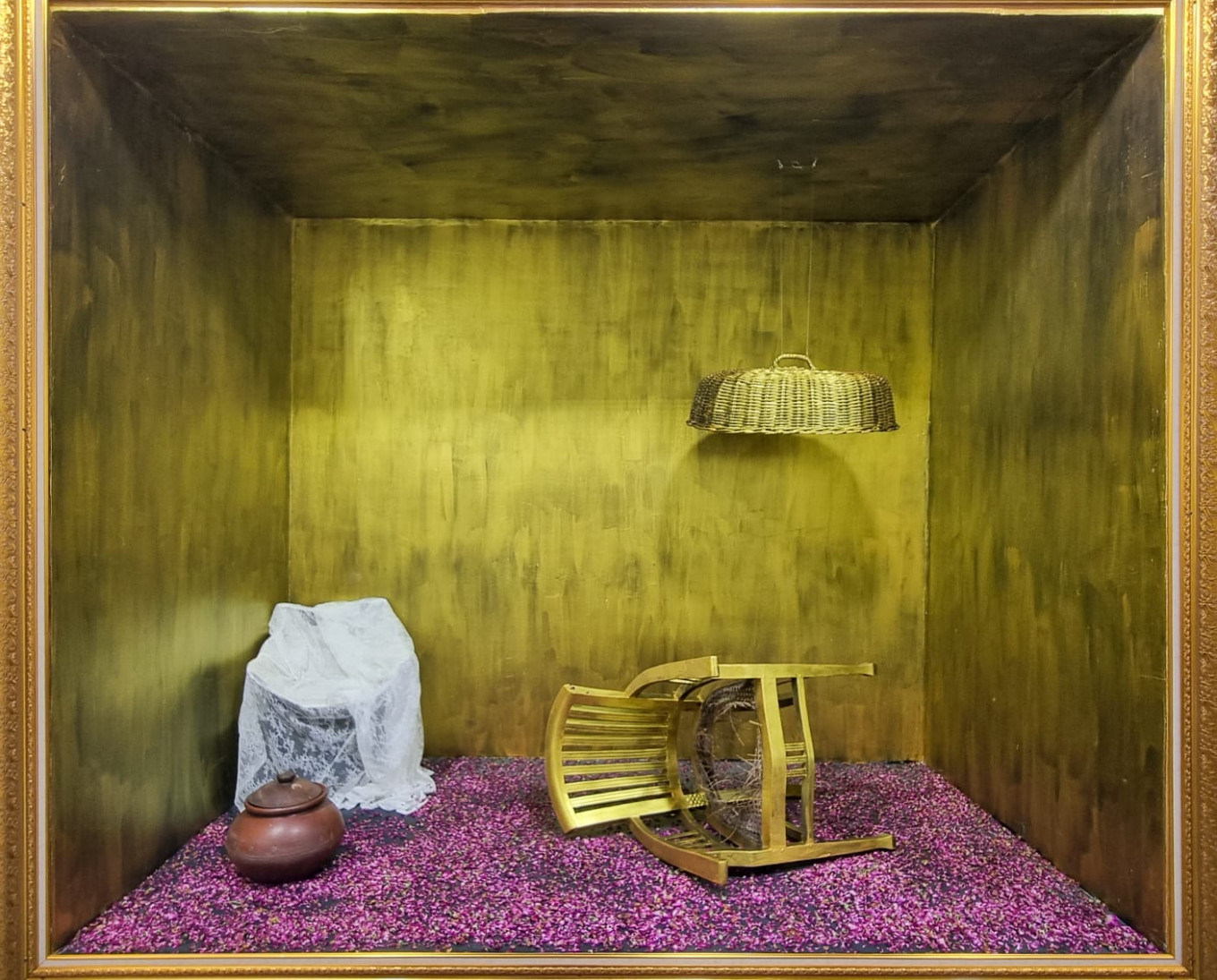 "Babad Tanah Leluhur Mantera Songga Langit" by Andita Purnomo Sari, installation/performance, 260 × 240 × 140 centimeters. (Courtesy of Mirah M. /-)
A
rt fairs are, by nature, commercial enterprises. Yet Art Moments Jakarta 2026 sought to challenge that expectation by placing cultural dialogue and human connection at the forefront of the viewing experience.
Under the curatorial theme “Offerings”, the fair moved away from the conventional booth-centric format that often reduces artworks to commodities and galleries to competing storefronts. Instead, cofounder and fair director Sendy Widjaja, working together with curator Jeong-ok Jeon, envisioned an exhibition environment in which artworks could be encountered on their own terms.
Known for her interest in connecting traditional cultural narratives with contemporary technologies and new media, Jeon developed a curatorial framework that encouraged contemplation rather than consumption. The result was a refreshing viewing experience. Visitors could move through the fair without feeling compelled to identify every work according to gallery representation, allowing the artworks themselves to take center stage.

Among the most striking presentations was Babad Tanah Leluhur, Mantra Songgo Langit #2 by interdisciplinary artist Andita Purnomo Sari, facilitated by the alternative art space and collaborative platform Ruang Garasi. Installed in a compact showroom-like setting, the work consisted of domestic furniture arranged upside down, creating an immediate sense of disorientation.
At first glance, the installation appeared chaotic. Yet beneath that chaos lay traces of a performance previously staged in the same space. The work seemed to recall historical narratives of upheaval while resonating with present-day uncertainties, transforming ordinary household objects into markers of collective instability.
Beyond conventional booths


More from The Weekender

Old habits, new China
What does it take to change a city’s habits? In Beijing, rising prosperity, better public spaces and ever-watchful cameras are reshaping how people behave — with room for a little old-fashioned unruliness

My mother’s magic jar of happiness
In a jar of notes left by her mother, Pallavi finds the small comforts of recovery as they become something to hold on to through the untethering force of grief.

Dari mana?
The question that asks where we are from sounds simple, but between distant homes, shifting identities and the worlds we inhabit on the page, our origins can be harder to pin down.