The Jakarta Post
Please Update your browser
Your browser is out of date, and may not be compatible with our website. A list of the most popular web browsers can be found below.
Just click on the icons to get to the download page.


Popular Reads
Top Results
No results found. Please check your search term and try again
Can't find what you're looking for?
View all search results
Popular Reads
Top Results
No results found. Please check your search term and try again
Can't find what you're looking for?
View all search results‘Siapa Bayar Apa Untuk Transisi Hijau?’: Mapping the road to renewable energy
Book brings together 10 contributors with expertise in environmental policy, banking and development economics.
Change text size
Gift Premium Articles
to Anyone
Share the best of The Jakarta Post with friends, family, or colleagues. As a subscriber, you can gift 3 to 5 articles each month that anyone can read—no subscription needed!
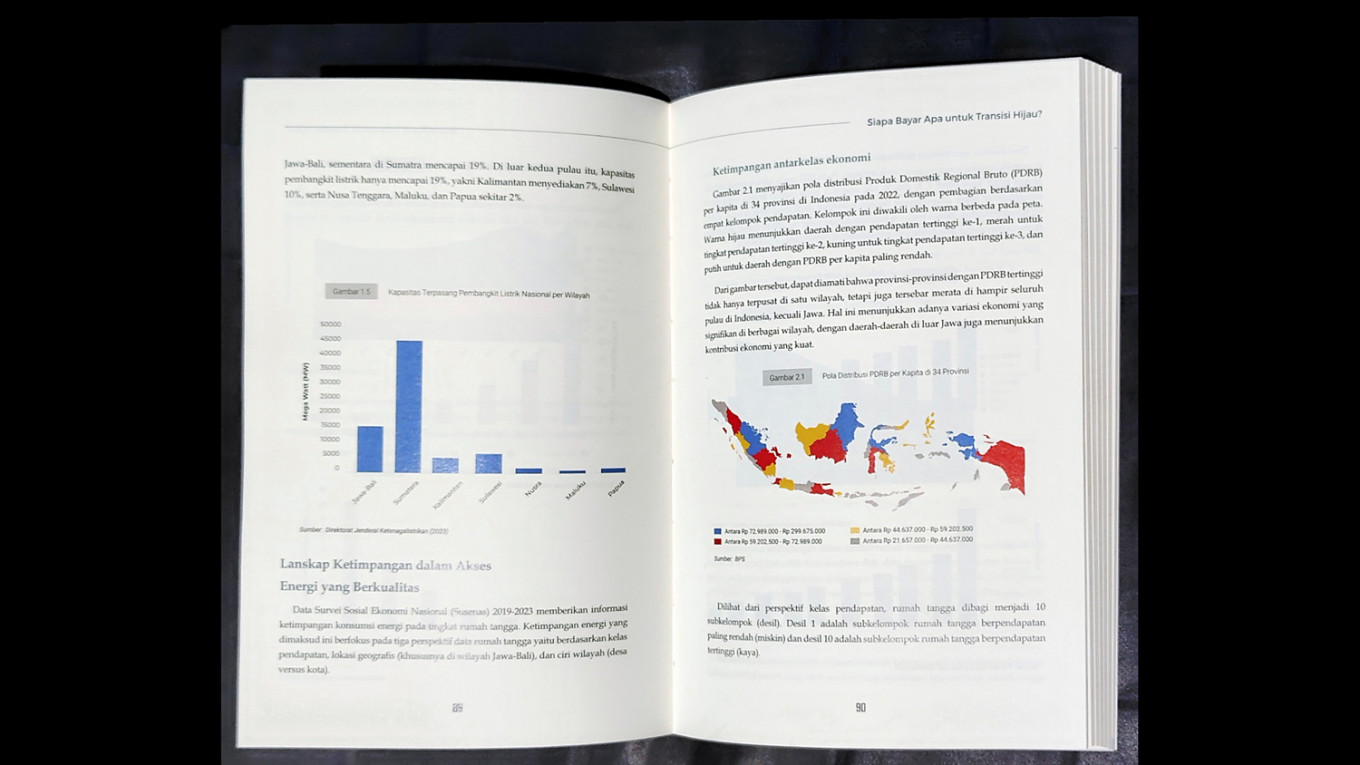 Visual explanation: 'Siapa Bayar Apa Untuk Transisi Hijau?' is embellished with colorful charts, maps and illustrations designed to make complex concepts more accessible to readers. These visuals also help lighten the technical nature of the subject matter.
JP/Sylviana Hamdani (JP/Sylviana Hamdani)
A
s the planet heats up and climate patterns grow increasingly erratic, the transition to green energy is no longer a choice. It is an urgent necessity. But change is rarely easy, especially when the stakes are high and the scale is vast.
For over a century, the global economy has been powered by coal, oil and gas. Replacing this deeply entrenched dependency with renewable energy is one of the most complex challenges of our time. It demands enormous financial investment and carries far-reaching social, economic and political consequences.
In Indonesia, these questions feel especially urgent. The government ratified the Paris Agreement through Law No. 16/2016, yet progress has remained painfully slow. Policy inertia, financial hurdles and deep-rooted structural barriers continue to stand in the way of meaningful reform.

A newly launched publication, Siapa Bayar Apa untuk Transisi Hijau? (Who pays what for the green transition?), brings this dilemma into sharp focus. Released recently in Jakarta, the 246-page book zeroes in on a critical question: Who will actually pay for Indonesia’s shift to renewable energy?
Initiated by Climate Policy Initiative (CPI) Indonesia, the book brings together 10 contributors with expertise in environmental policy, banking and development economics. At the helm of the editorial team are Adrian TP Panggabean and Albertus P. Siagian, economists whose careers have long spanned the worlds of finance and public policy.
Rather than offering quick fixes, the book dives deep, unpacking one of the most urgent and complicated challenges facing Indonesia today.
Unpacking the cost
More from The Weekender

Siapa Anda? Mengapa Anda?
What begins as a small grammatical curiosity becomes a larger question about language, culture and the way we understand ourselves in relation to others - and, ultimately, about what we risk losing in a world increasingly impatient with reflection, ambiguity and the humanities.

A passport to the kingdom of the sick
A breast cancer diagnosis, a journey to the kingdom of the sick and a determination to describe what lies there without metaphor, euphemism or the word “fight.”

The weight of time
Richard Mille’s newest ultralight timepiece pares down haute horlogerie to its mechanical necessities, proving that sophistication often comes from knowing what to leave out.