The Jakarta Post
Please Update your browser
Your browser is out of date, and may not be compatible with our website. A list of the most popular web browsers can be found below.
Just click on the icons to get to the download page.


Popular Reads
Top Results
No results found. Please check your search term and try again
Can't find what you're looking for?
View all search results
Popular Reads
Top Results
No results found. Please check your search term and try again
Can't find what you're looking for?
View all search resultsNew book offers new perspective on Banda massacre
A recently published book captures not only VOC governor-general Jan Pieterszoon Coen's cruelty in his attempt to monopolize the nutmeg trade in Banda, but also emphasizes the side of the story from the Bandanese diaspora who fled prior to the horrific Banda massacre in 1621.
Change text size
Gift Premium Articles
to Anyone
Share the best of The Jakarta Post with friends, family, or colleagues. As a subscriber, you can gift 3 to 5 articles each month that anyone can read—no subscription needed!
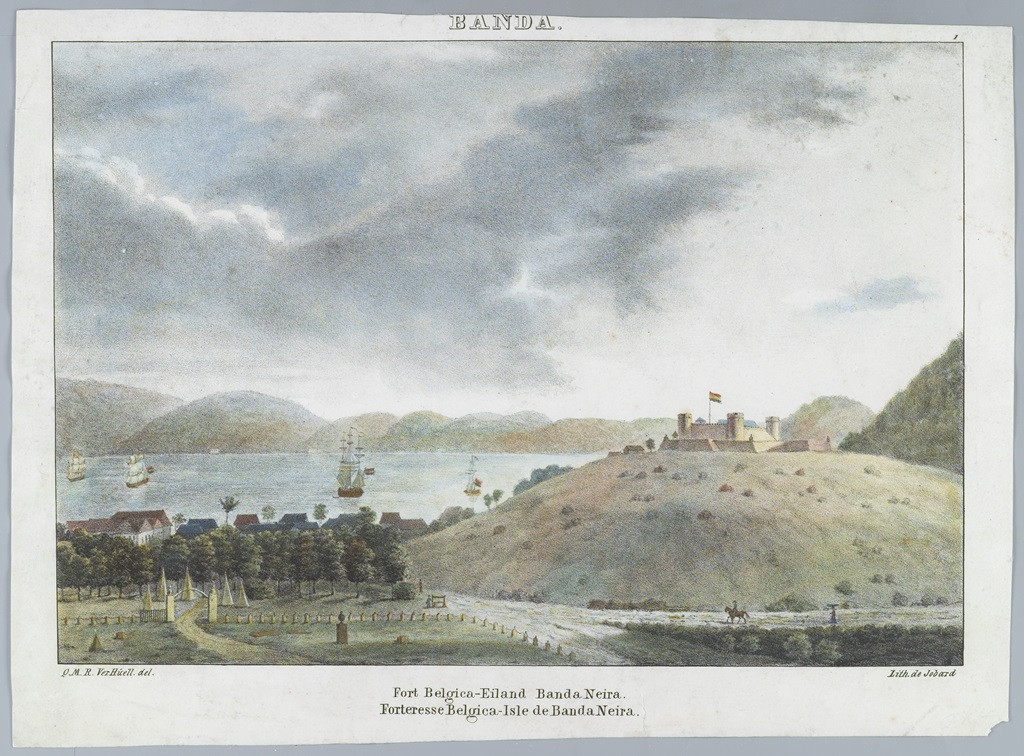 “Banda“ painted by QMR ver Huell and Jobard in 1824, shows the Dutch Fort Belgica-Eiland on Banda Neira Island in present day Maluku province. (Leiden University Libraries/KITLV 37C204)
M
ore than 400 years after the Banda massacre, Bandanese people have revealed in the book Genosida Banda (Banda Genocide) by Dutch historian Marjolein van Pagee, how their ancestors escaped from the bloody events and managed to keep their culture alive.
Banda was famous for the nutmeg that was cultivated on five islands of the Banda group, namely Greater Banda or Lontor, Naira, Run, Ay and Rozengain. It was a dominant region in the spice trade in the 17th century, with traders from various parts of the world, such as the Portuguese and Dutch, doing business with the Bandanese.
However, the Dutch attempted to force the Bandanese to sell their nutmeg exclusively to the Dutch East India Company (VOC) and this was met with resistance.

The horrific incident that followed was known as the Banda massacre in which, VOC governor-general Jan Pieterszoon Coen ordered the killing of thousands of Bandanese in 1621. Thousands more people from the Banda Islands were then forcibly moved to Batavia, now Jakarta, as captives. However, many of the Bandanese managed to escape prior to the massacre.
“Most of the time it's written that thousands of Bandanese were killed and nobody survived and those who survived were sent as slaves to Jakarta. And that is just not true, they were not in a hurry, they consciously fled because they knew what the Dutch were planning and they wanted to safeguard their family lines, their culture and religion,” Marjolein said.
In her book, Marjolein not only captures Coen's cruelty in his attempt to monopolize the nutmeg trade in Banda but also emphasizes the Bandanese diaspora’s side of the story.
The book was published in Dutch in April 2021, while the Indonesian version was launched at the Jakarta History Museum on Saturday by the Jakarta-based publisher Komunitas Bambu.



More from The Weekender

Citra Awards 2026: Who makes the cut?
An updated selection process brings fresh questions about recognition at the upcoming Citra Awards. Three movie-focused accounts weigh in on the favorites, the snubs and what makes a movie worthy of an ‘Indonesian Oscar’.

Old habits, new China
What does it take to change a city’s habits? In Beijing, rising prosperity, better public spaces and ever-watchful cameras are reshaping how people behave — with room for a little old-fashioned unruliness

My mother’s magic jar of happiness
In a jar of notes left by her mother, Pallavi finds the small comforts of recovery as they become something to hold on to through the untethering force of grief.