The Jakarta Post
Please Update your browser
Your browser is out of date, and may not be compatible with our website. A list of the most popular web browsers can be found below.
Just click on the icons to get to the download page.


Popular Reads
Top Results
No results found. Please check your search term and try again
Can't find what you're looking for?
View all search results
Popular Reads
Top Results
No results found. Please check your search term and try again
Can't find what you're looking for?
View all search resultsStrengthening the competitiveness of Indonesia's textile industry
The textile and textile products (TPT) industry employs approximately 3.96 million workers, nearly one-fifth of the total manufacturing workforce, and attracted investment of Rp 20.2 trillion (US$1.1 billion) in 2025.
Change text size
Gift Premium Articles
to Anyone
Share the best of The Jakarta Post with friends, family, or colleagues. As a subscriber, you can gift 3 to 5 articles each month that anyone can read—no subscription needed!
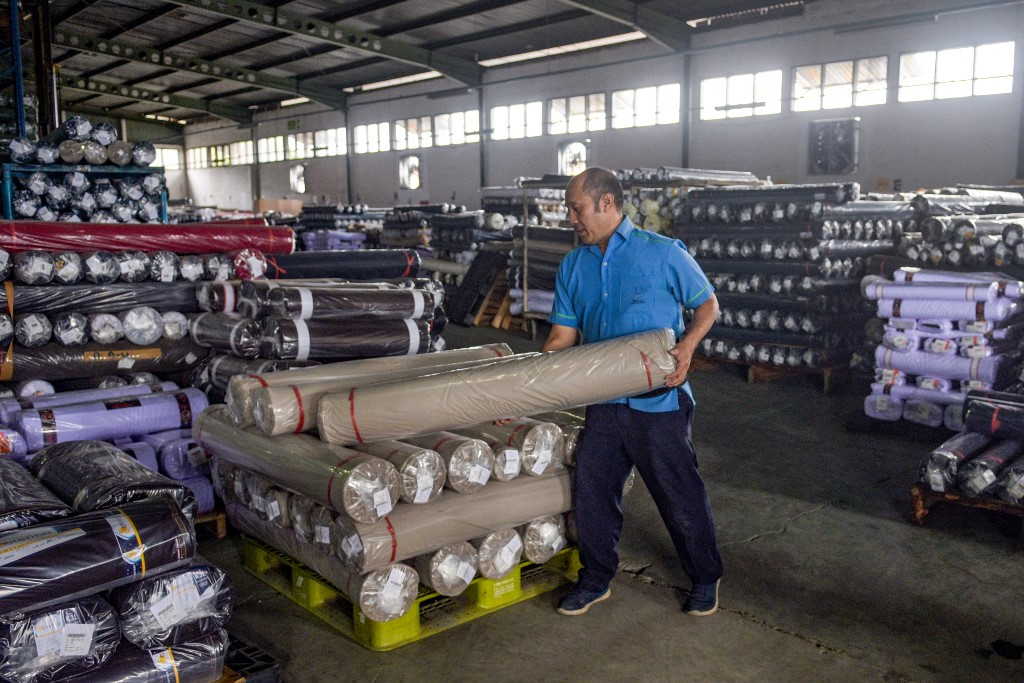 A worker stacks rolls of fabric ready for export at the Trisula Textile Industries factory in Cimahi, West Java, on April 15, 2025. (AFP/Timur Matahari)
T
he textile and textile products (TPT) industry is one of the strategic sectors of the Indonesian economy and has long played an important role in the development of the national manufacturing sector. As a labor-intensive industry, it employs approximately 3.96 million workers, or nearly one-fifth of the total manufacturing workforce. In 2025, the industry recorded exports of US$11.98 billion with a trade surplus of $2.77 billion and attracted investment of Rp 20.2 trillion ($1.1 billion).
The industry is thus a key source of employment, as well as a destination for investment.
Despite its significant role, the textile industry has faced increasingly complex pressures in recent years. Competition from other textile-producing countries, shifting patterns of global demand, uncertainty in international trade and geopolitical dynamics are among the factors affecting the industry's competitiveness.
These pressures are reflected in the industry's growth, which in recent years has lagged behind the manufacturing sector average. Wages rising faster than labor productivity have also eroded cost competitiveness. Meanwhile, the industry remains dependent on imported raw materials, leaving it vulnerable to rupiah depreciation, while widespread illegal imports continue to put pressure on the domestic market.
Amid these challenges, the national textile industry still has opportunities to improve its performance and strengthen its position in global supply chains. One such opportunity arises from escalating trade tensions between the United States and China, which have prompted global companies to diversify their production locations and reduce their dependence on any single country. This positions Indonesia as a potential alternative production base.
A further opportunity comes from the Indonesia-European Union Comprehensive Economic Partnership Agreement (IEU-CEPA), which is targeted to take effect in January 2027. The agreement will provide zero-tariff access for Indonesian textile products to the EU market. However, its benefits will only be fully realized if the industry is able to meet the rules of origin as well as the green product and green industry standards required by the EU.

In addition, the government's plan to establish a state-owned textile enterprise through state asset fund Danantara, built around the concept of an integrated upstream-to-downstream industrial area, could serve to strengthen the industry. Ideally, this state-owned enterprise should fill the gaps in the upstream segment, which has long been the source of import dependence and be developed through partnerships with the private sector so that it complements, rather than competes with, existing players.
To harness these opportunities and enhance the competitiveness of the national textile industry, strategic and integrated measures are required.
The first is to improve the investment climate in order to attract foreign direct investment (FDI). Such improvements include legal and regulatory certainty, simplified licensing, well-targeted incentives and support in the form of competitive infrastructure and energy supply.
FDI plays an important role in the development of the national textile industry. In addition to providing capital, foreign investors bring production facilities, advanced machinery and access to international markets that open up new export opportunities. Equally important is knowledge transfer in technical skills, quality control and management systems, which can raise the productivity and competitiveness of local workers and companies.
Furthermore, FDI need not be limited to wholly foreign-owned investment. It can also be channeled through partnerships with domestic businesses, including joint ventures.
In a joint venture, both parties not only pool their capital but also share technology, expertise and market networks, while local workers and management are directly involved in operations. Such partnerships should ensure that Indonesia not only serves as a production base but also strengthens its own technology, innovation and human capital.
Second, the textile industry should be encouraged to act not only as a manufacturer but also as a creator and owner of brands through the emergence of local brand champions. To date, many domestic textile companies have operated as contract manufacturers, and their profits are therefore limited to the production stage, while the value generated from design, marketing and customer relationships accrues to brand owners. Hence, the shift from a "make for others" to a "create and own" model must be supported by investment and innovation to strengthen Indonesia's position in the global value chain.
Third, consistent investment is needed in machinery modernization, production technology and research and development (R&D). R&D plays an important role in generating innovations in design, new materials and more efficient production processes, while also helping companies understand consumer trends so that their products compete not only on price but also on quality and distinctiveness.
In addition, human resource capabilities must be strengthened through vocational training and skills certification, enabling Indonesia's textile industry to increase its value added and competitiveness in the global market. Various fiscal and financing incentives for machinery modernization are already available, but their utilization still needs to be expanded.
Fourth, the enforcement of trade remedy instruments such as safeguard duties and anti-dumping duties must be accompanied by stricter oversight of illegal imports. Without such oversight, illegal imports will continue to erode the domestic market and undermine the effectiveness of existing policies.
In conclusion, the national textile industry still has substantial opportunities to grow amid various global challenges. Capitalizing on shifts in global supply chains must be accompanied by technological modernization, greater innovation, stronger human resources and the development of local products and brands. Through these measures, Indonesia will be able not only to increase production and exports but also to enhance the value added and competitiveness of its textile industry in the global market.
*****
The writer is an industry and regional analyst at Bank Mandiri.