The Jakarta Post
Please Update your browser
Your browser is out of date, and may not be compatible with our website. A list of the most popular web browsers can be found below.
Just click on the icons to get to the download page.


Popular Reads
Top Results
No results found. Please check your search term and try again
Can't find what you're looking for?
View all search results
Popular Reads
Top Results
No results found. Please check your search term and try again
Can't find what you're looking for?
View all search resultsInvestors brace for gridlock as Democrats projected to win House
Change text size
Gift Premium Articles
to Anyone
Share the best of The Jakarta Post with friends, family, or colleagues. As a subscriber, you can gift 3 to 5 articles each month that anyone can read—no subscription needed!
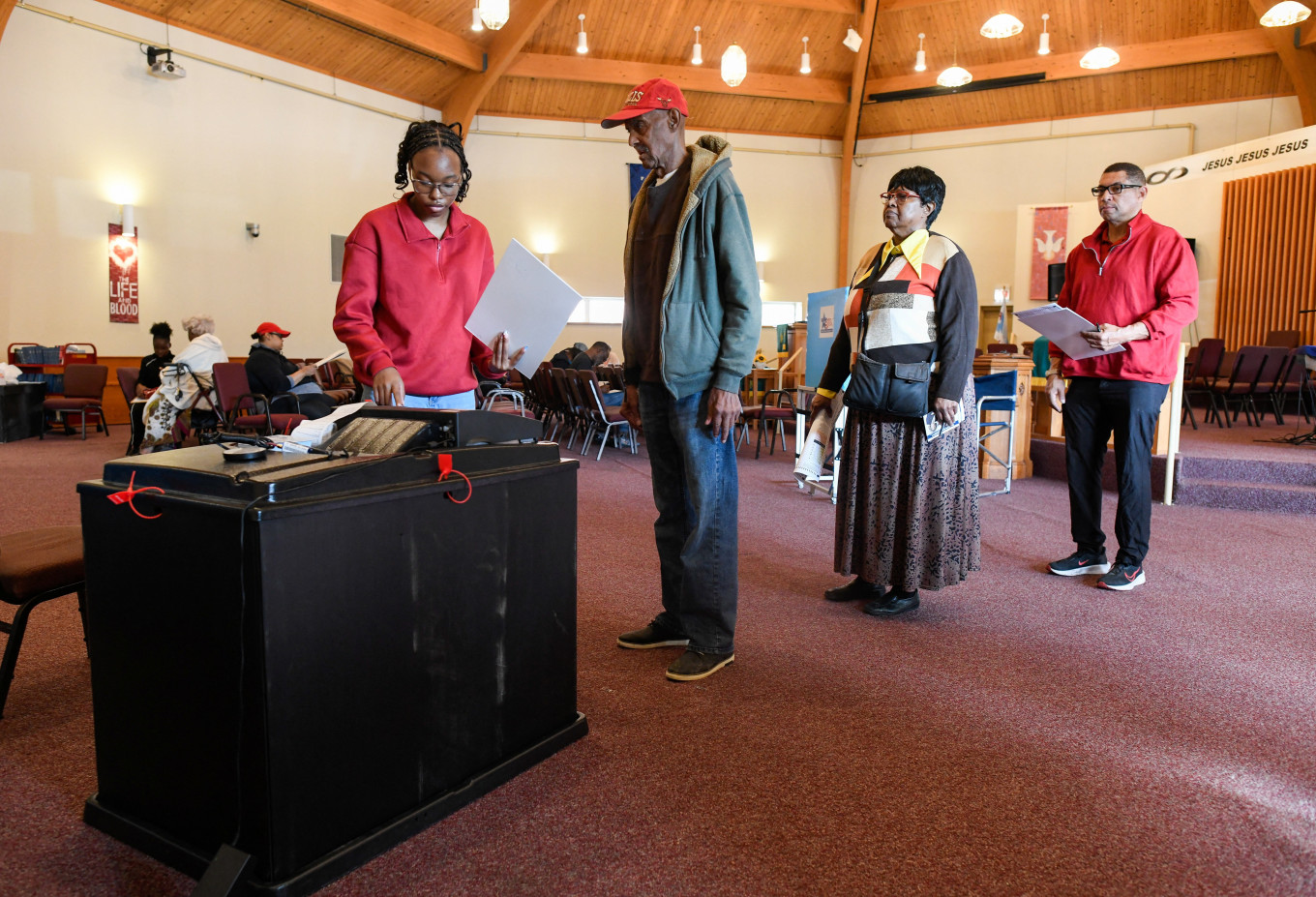 A poll worker assists voters during the US midterm elections at Pullman Presbyterian Church, in Chicago, Illinois, US, on Nov. 3, 2026. (Reuters/Octavio Jones)
I
nvestors faced the potential for tougher regulation and oversight in areas such as AI as well as for legislative gridlock that could complicate the fiscal picture, as Democrats gained ground in the battle to wrest control of Congress from the Republicans.
Decision Desk HQ projected the Democrats to win control of the House of Representatives in Tuesday's US midterm elections.
The party's victory in the House was widely expected, though control of the Senate remained in the balance. President Donald Trump's Republican Party controlled both chambers of Congress during the first two years of his second term.
"There's still a number of areas where President Trump can influence the markets - trade and tariffs, foreign policy, and existing regulations," said Tai Hui, chief market strategist for Asia-Pacific at J.P. Morgan Asset Management in Hong Kong.
But even if a so-called "blue wave" were materializing, Democrats appeared unlikely to gain the two-thirds supermajority needed to override Trump's veto power, he said. "That will be one of the sticking points for the remaining two years of President Donald Trump's term," Hui added.
Stock index futures swooned on Tuesday evening, with the S&P 500 futures down 1.1 percent and Nasdaq futures off 2 percent.

The US dollar index, which measures the greenback's strength against a basket of six currencies, was down 0.4 percent at a one-month low of 101.30.
"I don't think the big risk to markets is from the blue wave; it's investors overreacting to a blue wave," said Michael Arone, chief investment strategist, State Street Global Advisors in Boston.
"The bark is often worse than the bite," he added, of the possibility of Democrats winning control not only of the House but also the Senate. "As time passes, historically the periods after midterms are strong for markets."
Tuesday's outcome could hold broad implications for market-sensitive areas including the AI data-center buildout, the US fiscal outlook, defense spending and regulation in areas such as healthcare, banking and cryptocurrencies.
Opinion polls had shown the Democrats likely to take the House, with the Senate too close to call, but early results indicated the party ahead in several states, flipping a Republican-held Senate seat in North Carolina and showing surprising strength across several Republican-leaning House districts in Florida.
"If the Democrats have a larger majority in the House and Senate, I think that could put some pressure on the technology trade," said Anthony Saglimbene, chief market strategist at Ameriprise.
As polls began to close, prediction market prices implied a 100 percent chance of Democrats taking the House and a 99 percent chance of them winning the Senate, according to pricing data from the major markets aggregated by analytics firm BetInt.
The midterms come at a fragile time for markets, with a swoon in AI shares causing investor unease that could be exacerbated by the election results. As Asian trade began, Japan's Nikkei 225 was down 3.6 percent, reopening after a holiday. MSCI's broadest index of Asia-Pacific shares outside Japan was down 1 percent, led by a 3 percent decline in Korean shares.
A Democratic-led Congress could exert greater scrutiny over AI companies, in part due to growing public opposition to data centers, a risk for a market that has been lifted by such investments. While analysts see slim chances of viable legislation that would severely undermine the data-center buildout, they expect a Democratic sweep to lead to investigations into the technology sector.
Investors also watching governor races
Investors were also watching governor and other local races in states such as Texas for their implications for the AI buildout.
"The AI trade has been so important to the market, and this election will have some direct impact on that," said Chuck Carlson, chief executive officer at Horizon Investment Services.
Investors also faced the potential for increasing legislative gridlock should Democrats win both chambers of Congress. That could raise the specter of stalling budget negotiations and complicate the fiscal picture that has already rattled asset prices.
Alex Morris, founder of F/m Investments, said investors could increasingly focus on fiscal issues in the coming weeks. "And frankly, no candidate ran on a platform of fiscal responsibility," Morris said.
Many investors have said they are eager to get past the elections, which have hung over the markets for weeks. In midterm years since 1946, the S&P 500 has been higher 12 months after Election Day in all 20 instances, with an average gain of 14.4 percent, according to Deutsche Bank.
Other investors expressed skepticism about the implications for US government policy.
"This is basically an imperial presidency that operates by executive orders," said Jesper Koll, expert director at Monex Group in Tokyo. "So the fact that it looks like Congress is turning Democrat, I personally doubt that's going to have much of an impact on actual policymaking."