The Jakarta Post
Please Update your browser
Your browser is out of date, and may not be compatible with our website. A list of the most popular web browsers can be found below.
Just click on the icons to get to the download page.


Popular Reads
Top Results
No results found. Please check your search term and try again
Can't find what you're looking for?
View all search results
Popular Reads
Top Results
No results found. Please check your search term and try again
Can't find what you're looking for?
View all search resultsIndonesia’s digital trade opportunity starts at home
Closing digital gaps matters as ASEAN prepares to sign the Digital Economy Framework Agreement (DEFA) in November 2026, following the conclusion of negotiations.
Change text size
Gift Premium Articles
to Anyone
Share the best of The Jakarta Post with friends, family, or colleagues. As a subscriber, you can gift 3 to 5 articles each month that anyone can read—no subscription needed!
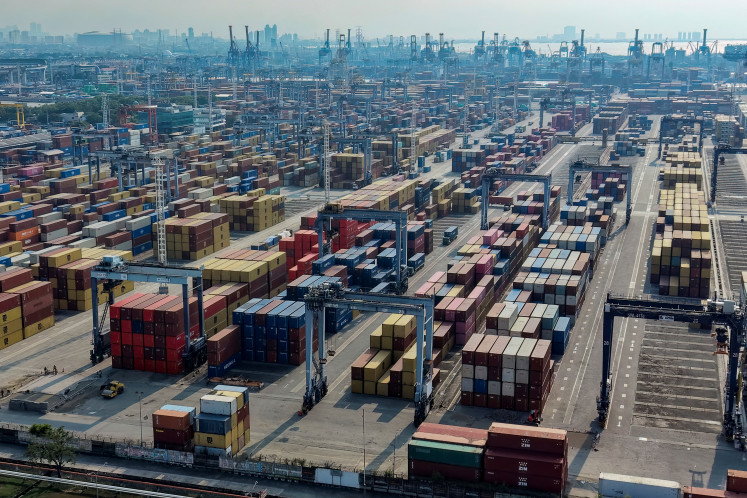
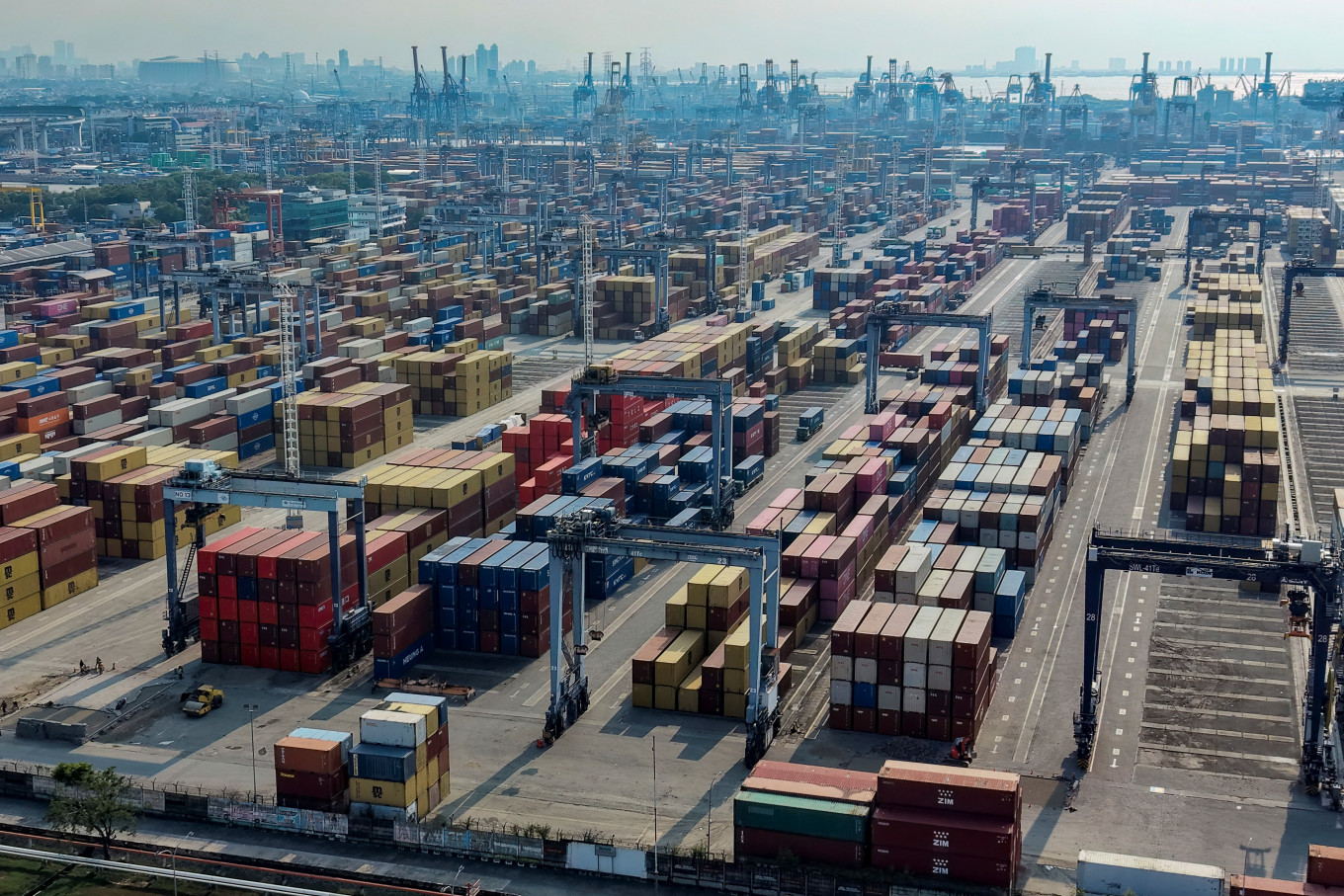 Stacks of shipping containers at Tanjung Priok Port, Jakarta, on March 31, 2026. (AFP/Bay Ismoyo)
I
ndonesia has set a herculean target for its digital economy to contribute 12-13 percent of gross domestic product by 2029. That ambition builds on a decade of digitalization that has expanded digital markets and brought more public services online. Google, Temasek and Bain & Company’s e-Conomy SEA report highlighted the scale of these markets is reflected in the US$99 billion in gross merchandise value (GMV) projected for 2025.
In public services, the same shift is also visible in trade administration. Businesses can now file customs declarations, apply for import and export permits, submit cargo manifests and pay duties electronically.
Putting each procedure online is only the first step. Business shipping goods abroad may still have to enter the same shipment details separately for permits, customs, banks and logistics providers. Closing these gaps matters as ASEAN prepares to sign the Digital Economy Framework Agreement (DEFA) in November 2026, following the conclusion of negotiations.
The agreement aims to make digital transactions across ASEAN easier and more secure by supporting data sharing, electronic payments and better connections between systems. This could help Indonesian firms, including smaller businesses, reach customers and trade more easily within the region. For Indonesia, DEFA offers a timely opportunity to connect its domestic trade systems: firms will be better placed to benefit from regional connections when their information can already be exchanged and reused at home.
The difficulty lies in a focus on digitizing individual procedures, with less attention to how they work together. Moving forward requires integration to connect systems within an organization and interoperability to allow different organizations to exchange and reuse information.
Then, orchestration that will coordinate the systems, procedures and responsibilities across a transaction, from permits to payment. Indonesia needs to advance through these stages, moving forward from digitizing, and start to measure progress by how easily businesses can complete the whole trade process.

The two gaps
Moving beyond digitization requires closing two gaps: within firms, and between firms and government.
The first concerns how businesses manage their own operations. Joint-survey of BCG and Telkom on 3,763 Indonesian small and medium enterprises (SMEs) in 2022 highlighted that finding suppliers and reaching customers were common digital activities, adopted by 65 percent and 63 percent of respondents respectively. Meanwhile, for the purpose of business process, such as digital tools and analytics, digital utilization only reached 26-27 percent. These findings suggest that digital market access had advanced faster than the use of technology to manage internal operations.
The second gap concerns how firms exchange information with government. Different definitions, data formats and verification methods can prevent information from being reused between systems across institutions. Consequently, businesses can then face repeated document submissions and administrative steps, even when the services are online. Addressing this requires shared definitions, compatible formats and agreed verification rules so firms and agencies can use and trust the same information.
This challenge becomes more complex across borders. The 2025 United Nations Global Survey on Digital and Sustainable Trade Facilitation gave Indonesia implementation scores of 96.3 out of 100 for domestic paperless trade and 66.7 for cross-border paperless trade. The difference points to unfinished arrangements for exchanging and recognizing electronic records internationally.
Cross-border connections will be easier to build when firms have reliable internal records and domestic agencies can accept and reuse them. Closing both domestic gaps would give Indonesia a stronger foundation for regional digital trade.
Best-practice from QRIS
QRIS shows that Indonesia can coordinate a diverse digital ecosystem through a common standard. Merchants can accept payments from different banks and wallets using one QR code, without setting up a separate connection with each provider.
The success story of QRIS also reflected on the first half of 2025, it had reached 57 million users and 39.3 million merchants, with MSMEs accounting for 93.16 percent of merchants. Transaction volume reached 6.05 billion, worth Rp 579 trillion ($31.5 billion). These results demonstrate how shared standards and a simple user experience can support widespread adoption.
QRIS’ overall strategy cannot be copied directly into digital trade, where transactions involve more institutions, documents and legal responsibilities. However, the principles behind QRIS’ success can be replicated in digital trade: establish common standards, design systems to connect from the start, preserve competition on prices and services, as well as keep transactions simple for users.
Putting these principles into practice would mean building shared data standards into the accounting, banking and logistics software firms already use. Firms could then exchange information with agencies and providers without setting up a separate technical arrangement for each connection. This would reduce the burden of connecting to multiple systems and help businesses complete trade procedures through familiar tools.
Maximize digital trade opportunity
Indonesia should make the full trade transaction the focus of its digital readiness assessments. These assessments should follow real transactions from order through delivery and payment, measuring time, cost and repeated data entry at each stage. The results would show where online procedures still fail to work together and which obstacles impose the greatest burden on firms.
These findings should guide a coordinated reform agenda, drawing on the example set by QRIS. Its principles provide a practical basis for agencies and businesses to work together on the bottlenecks identified. Each priority should have a clear institutional owner and measurable outcomes, keeping Indonesia’s digital trade agenda focused on improvements that businesses can experience.
DEFA offers an opportunity to extend these improvements across ASEAN as the region pursues a more connected digital economy. As DEFA becomes part of ASEAN’s economic framework, Indonesia will have to adapt to a trading environment increasingly shaped by digitalization.
Indonesia should use evidence from these assessments to shape implementation priorities with its regional partners. Building this readiness is essential to making the most of DEFA. The test of Indonesia’s digital ambition will be whether firms can turn greater regional connectivity into trade that is easier, faster and less costly to complete.
*****
Prayoga Wiradisuria is director of policy and program at the Indonesian Business Council (IBC), while Bima Nur M.R. is a policy and program analyst at IBC.