The Jakarta Post
Please Update your browser
Your browser is out of date, and may not be compatible with our website. A list of the most popular web browsers can be found below.
Just click on the icons to get to the download page.


Popular Reads
Top Results
No results found. Please check your search term and try again
Can't find what you're looking for?
View all search results
Popular Reads
Top Results
No results found. Please check your search term and try again
Can't find what you're looking for?
View all search resultsWRI Indonesia launches working paper on corporate green power demand
The collaborative study found that companies in Indonesia preferred straightforward and affordable green power procurement options, and that most saw unbundled renewable energy certificates (RECs) as the best short-term option.
Change text size
Gift Premium Articles
to Anyone
Share the best of The Jakarta Post with friends, family, or colleagues. As a subscriber, you can gift 3 to 5 articles each month that anyone can read—no subscription needed!
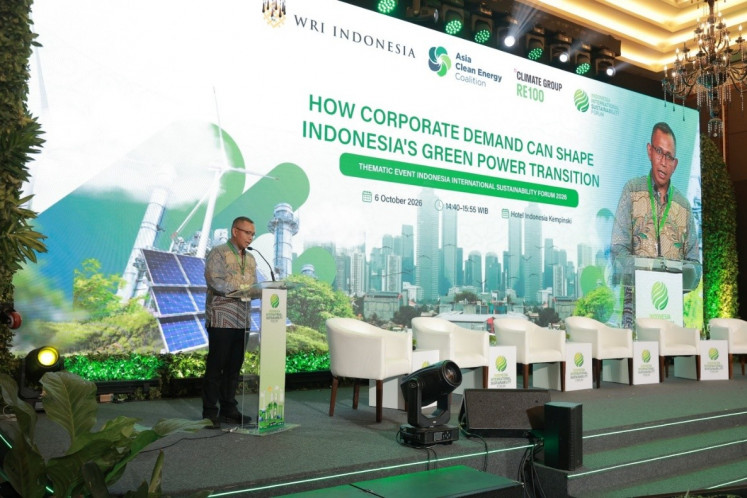
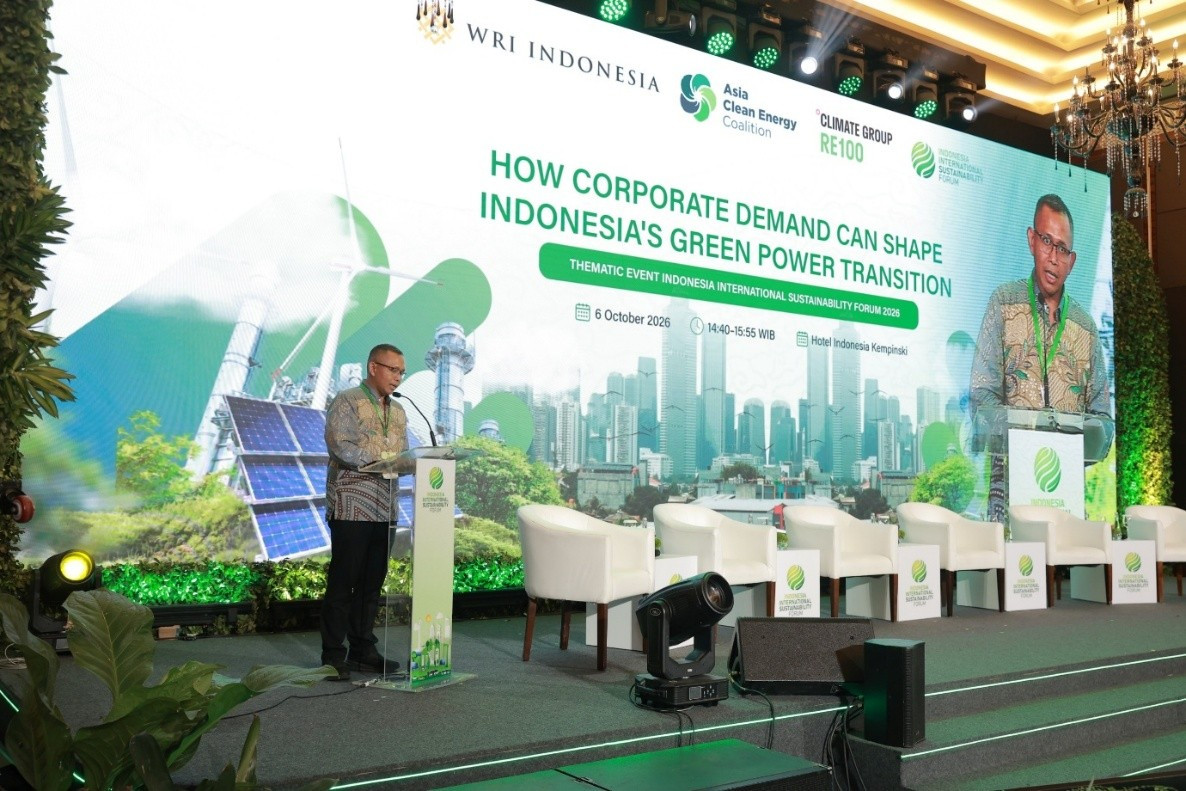 Arief Wijaya, managing director of the World Resources Institute (WRI) Indonesia, speaks during the launch of its working paper “Corporate green power procurement options in Indonesia” on Oct. 6 at the Indonesia International Sustainability Forum 2026 in Jakarta. (Images courtesy of WRI Indonesia)
T
he World Resources Institute (WRI) Indonesia has published a working paper detailing Indonesia’s corporate green power demand, highlighting the rising adoption of new and renewable energies as companies aim to lower their carbon emissions.
Produced in collaboration with the Asia Clean Energy Coalition (ACEC), the paper, titled “Corporate green power procurement options in Indonesia: Taking stock of demand and charting the path forward”, was launched on Oct. 6 at the Indonesia International Sustainability Forum in Jakarta.
WRI Indonesia managing director Arief Wijaya said the study aimed to address obstacles faced by companies and translate their needs into a space to further develop green and renewable energy.
“For the business sector, access to green electricity is increasingly becoming part of their business strategies,” Arief said.
“Companies need it to reduce emissions, meet customer requirements, maintain access to export markets and fulfill commitments within global supply chains. The availability of clean electricity can also influence investment decisions and the expansion of production capacity.
“Therefore, Indonesia's ability to meet this demand is closely linked to industrial competitiveness and investment attractiveness,” he explained.

According to Arief, companies want green electricity that is affordable and reliable while also having renewable energy sources and attributes that can be verified. They also require procurement options that align with their business scale, electricity consumption patterns and the sustainability standards they must meet.
The desire to use green electricity, however, does not always translate into actual procurement decisions. Indonesia still needs to expand available options, increase certainty and align customer needs with renewable energy development for electricity supply.
“This is where corporate demand makes a significant contribution,” Arief said.
“Measurable and credible demand can serve as vital input for power sector planning and renewable energy investment. We need a shared understanding of the scale of corporate needs, the locations and timing of those needs and the companies' readiness to make procurement commitments.”
Rising global demand
As of August 2026, more than 11,000 companies worldwide, representing over 40 percent of the global market capitalization, have had their emission reduction targets validated by the Science Based Targets initiative (SBTi).
Of the more than 400 companies that pledged to achieve 100 percent renewable energy in their global operations by 2050 under the Climate Group’s RE100 global initiative, 133 companies including Danone, Unilever and Google operate or maintain supply chains in Indonesia. According to the 2024 RE100: Annual disclosure report, these 133 member companies recorded annual electricity consumption of 3 terawatt-hours (TWh), which the WRI paper notes is a fraction of Indonesia’s corporate renewable electricity potential.
Access to green electricity is becoming increasingly critical for companies and their suppliers to meet such targets, and the availability of green electricity procurement options that align with corporate needs is closely linked to Indonesia’s industrial competitiveness and investment attractiveness.
In Indonesia’s electricity market, companies can utilize four types of green electricity procurement mechanisms: on-site power generation; unbundled energy attribute certificates known as RECs; contracts with state electricity firm PLN via green energy as a service (GEAS) direct source (DS); and direct contracts with off-site power generators.
A survey of 56 companies indicates that RECs remain the most widely used procurement option today, with 49 percent of respondents opting for this mechanism.
Clorinda Wibowo, senior manager for energy and sustainable business at WRI Indonesia, noted that businesses tended to prefer RECs for their relative ease in procurement.
However, the paper also found that the existence of a mechanism did not necessarily mean it was easily accessible. Grid-connected rooftop solar installations are subject to quota restrictions, while direct contracts with off-site generators are currently available only within privately licensed electricity service areas; broader access still requires regulatory and implementation clarity.
The survey indicated increasing diversification in the scenario for the next five to 10 years, as most respondents (37 percent) expressed interest in on-site generation. Meanwhile, 29 percent still preferred RECs and 23 percent preferred contracts with off-site generators.
“Seventy-nine percent of our respondents highlight cost as their main consideration, as while there are add-on tariffs and premiums, companies want to keep them as affordable as possible. Ease of permitting is also crucial, as they want both ease as well as coverage for most of their preset needs,” Clorinda explained.
From the government's perspective, industrial needs also constitute important information for the development of electricity policy and planning. The Energy and Mineral Resources Ministry is currently examining system models from other countries, including details of licensing processes and cross-sector coordination.
“Providing green electricity is not solely a matter for the energy sector. Underlying this provision is the need for complex cross-sector coordination involving sectors such as land use, forestry and agriculture to ensure that the supply we develop can be effectively utilized and meet ever-growing demand,” said Dr. Nanda Avianto Wicaksono, coordinator for power transmission and distribution planning at the ministry’s Directorate of Electricity Program Development.
As standards are continuously developing, including RE100 technical requirements for newer facilities, companies are also looking at the age of power plants to meet international procurement criteria. In addition, clear attribute ownership, transparent tracking and residual emission factors are necessary to prevent double counting and support credible claims.
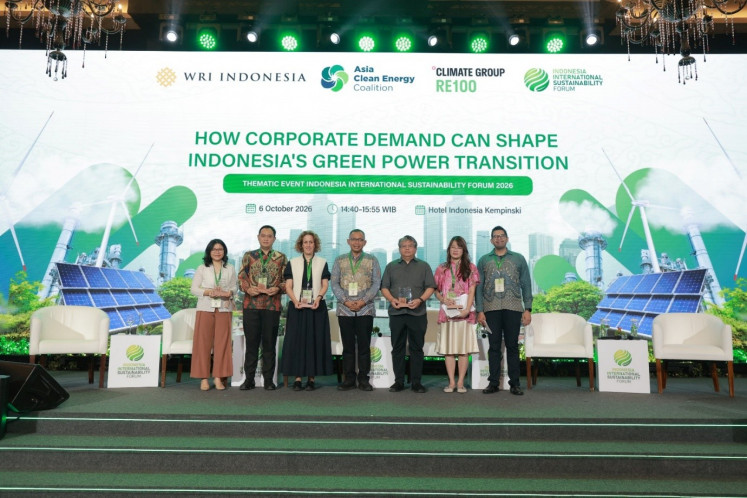
“When designing clean electricity procurement policies in Indonesia, it is important not only to look at companies' current needs but also to consider their requirements for the next three, five and even 10 years,” said Mia Nguyen, ACEC’s chief of staff and strategic initiatives.
“ACEC is committed to supporting Indonesia in developing its own path, a path that can continue to evolve alongside the changing needs of companies while also reflecting market characteristics and the requirements of Indonesia’s power system,” she said.
The paper proposes adding new power plants to PLN’s REC program and updating grid and residual emission factors to prevent double counting, noting that alternative procurement options still need to be developed to meet buyers' requirements for additionality.
“Over time, we will be able to see the scale of the demand as well as their locations. Indonesia also has the 2025-2034 Electricity Supply Business Plan [RUPTL] from PLN, as well as big ambitions on building more renewable energy such as the 100 gigawatt-peak photovoltaic system,” Clorinda said.
“In the end, it’s also how supply and demand can match, and the approach in energy planning for renewables will be different in how we’ve approached fossil fuels,” she said.