The Jakarta Post
Please Update your browser
Your browser is out of date, and may not be compatible with our website. A list of the most popular web browsers can be found below.
Just click on the icons to get to the download page.


Popular Reads
Top Results
No results found. Please check your search term and try again
Can't find what you're looking for?
View all search results
Popular Reads
Top Results
No results found. Please check your search term and try again
Can't find what you're looking for?
View all search resultsMiddle East war sharpens focus on ASEAN energy security plans
ASEAN imports more than half of the crude for its refineries from the Middle East at a time when global benchmark prices are around US$100 a barrel.
Change text size
Gift Premium Articles
to Anyone
Share the best of The Jakarta Post with friends, family, or colleagues. As a subscriber, you can gift 3 to 5 articles each month that anyone can read—no subscription needed!
 Set as preferred source
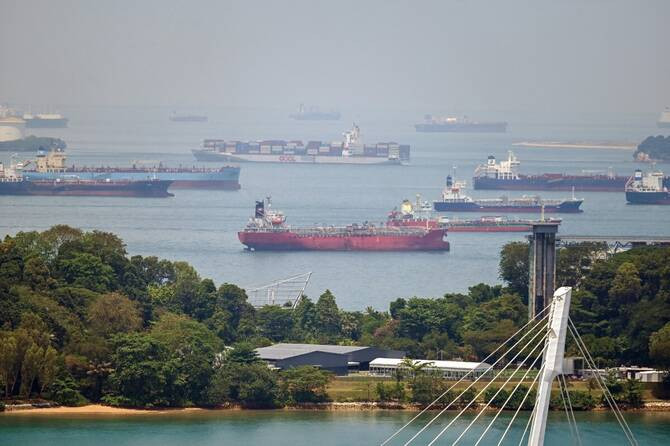
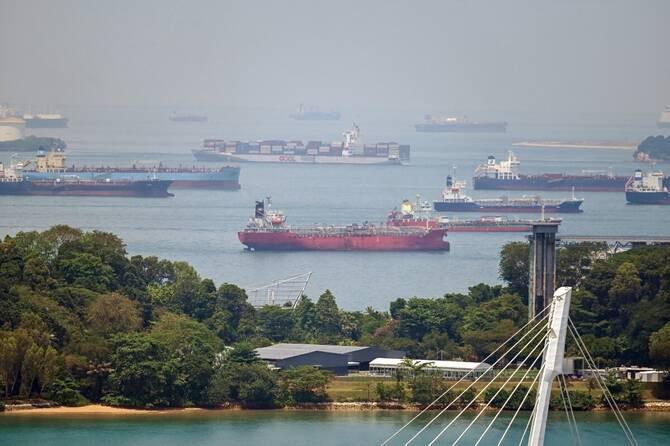 A container ship sails past oil tankers anchored in the Singapore Strait, a key gateway to the Strait of Malacca, on April 14, 2026. (AFP)
S
outheast Asian energy ministers meeting in Manila this week face the prospect of a prolonged Middle East war that has exposed the region's vulnerabilities to imported energy.
As the US-Israeli war against Iran drags on, there is increased urgency for ASEAN to implement its proposed energy security plans and reduce its exposure to price shocks caused by attacks on infrastructure and shipping routes in the Middle East.
ASEAN imports more than half of the crude for its refineries from the Middle East at a time when global benchmark prices are around US$100 a barrel. The conflict has also sharpened concerns about broader energy security risks as Chinese refiners have suspended oil product exports for October.
Against that backdrop, energy ministers meeting in Manila are expected to review regional fuel-security measures launched after emergency talks earlier this year, including efforts to put into effect coordinated emergency responses under the ASEAN Framework Agreement on Petroleum Security (APSA).
Long-term initiatives, including the ASEAN Power Grid and renewable-energy deployment, are also on the agenda.
“What the crisis brought was a sharper focus on resiliency,” Philippine Energy Undersecretary Felix Fuentebella told Reuters on Oct. 1, saying energy security had moved from a technical issue to a priority for ASEAN ministers and leaders.

Lower earnings
The higher prices are raising the costs for the region's households and eating into the earnings of transport workers.
“We hardly take anything home anymore,” said Antonio Bandin, a Manila jeepney driver who joined a protest last week over rising fuel prices. His working fuel bill has more than doubled to about 2,400 pesos ($38) per day.
The ASEAN Centre for Energy warned in a policy paper that a severe disruption to Middle East supplies could place oil volumes equivalent to nearly 28 percent of ASEAN's final oil consumption at risk, underscoring the need for stronger regional petroleum-security arrangements.
But the region's insufficient storage capacity and inventories remain obstacles to implementing APSA, Alloysius Joko Purwanto, senior energy economist at the Economic Research Institute for ASEAN and East Asia, warned on Friday during a webinar hosted by the Center for Strategic and International Studies.
Energy Secretary Sharon Garin has said the Philippines, which remains under a national energy emergency, is exploring regional fuel-stockpiling arrangements and could host future storage projects.
But analysts cautioned that such measures are unlikely to affect the present crisis.
“This is more about preparing for the next crisis. A reserve is a buffer. It is not a strategy,” Christopher Len, a senior fellow at the ISEAS-Yusof Ishak Institute, said in the same webinar, referring to regional stockpiling initiatives.
Ministers are also expected to discuss ways to reduce long-term dependence on imported fuels. Renewable energy, electric vehicles, and energy efficiency are expected to feature prominently.
The International Energy Agency estimates Southeast Asia's energy import bill could rise from more than $80 billion in 2024 to about $245 billion by 2035 without structural change.
The IEA said wider electrification, including electric vehicles and biofuels, would help curb oil demand and reduce exposure to volatile fuel imports, while cross-border links under the ASEAN Power Grid that would integrate the region's electrical network will require about $27 billion in investment by 2040.
“We should actually use this shock as a lesson to reduce exposure, not only to cushion it,” Len said.