The Jakarta Post
Please Update your browser
Your browser is out of date, and may not be compatible with our website. A list of the most popular web browsers can be found below.
Just click on the icons to get to the download page.


Popular Reads
Top Results
No results found. Please check your search term and try again
Can't find what you're looking for?
View all search results
Popular Reads
Top Results
No results found. Please check your search term and try again
Can't find what you're looking for?
View all search resultsLong-term sectoral growth patterns: What should we focus on?
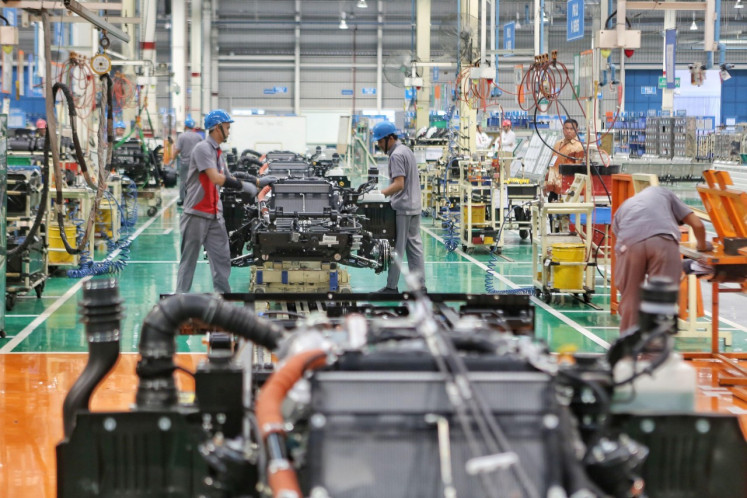
The manufacturing sector’s contribution to GDP remains substantial, 19.1 percent in 2025, but its growth has lagged behind national growth, causing its share of GDP to decline over the past 15 years.
Change text size
Gift Premium Articles
to Anyone
Share the best of The Jakarta Post with friends, family, or colleagues. As a subscriber, you can gift 3 to 5 articles each month that anyone can read—no subscription needed!
 Set as preferred source
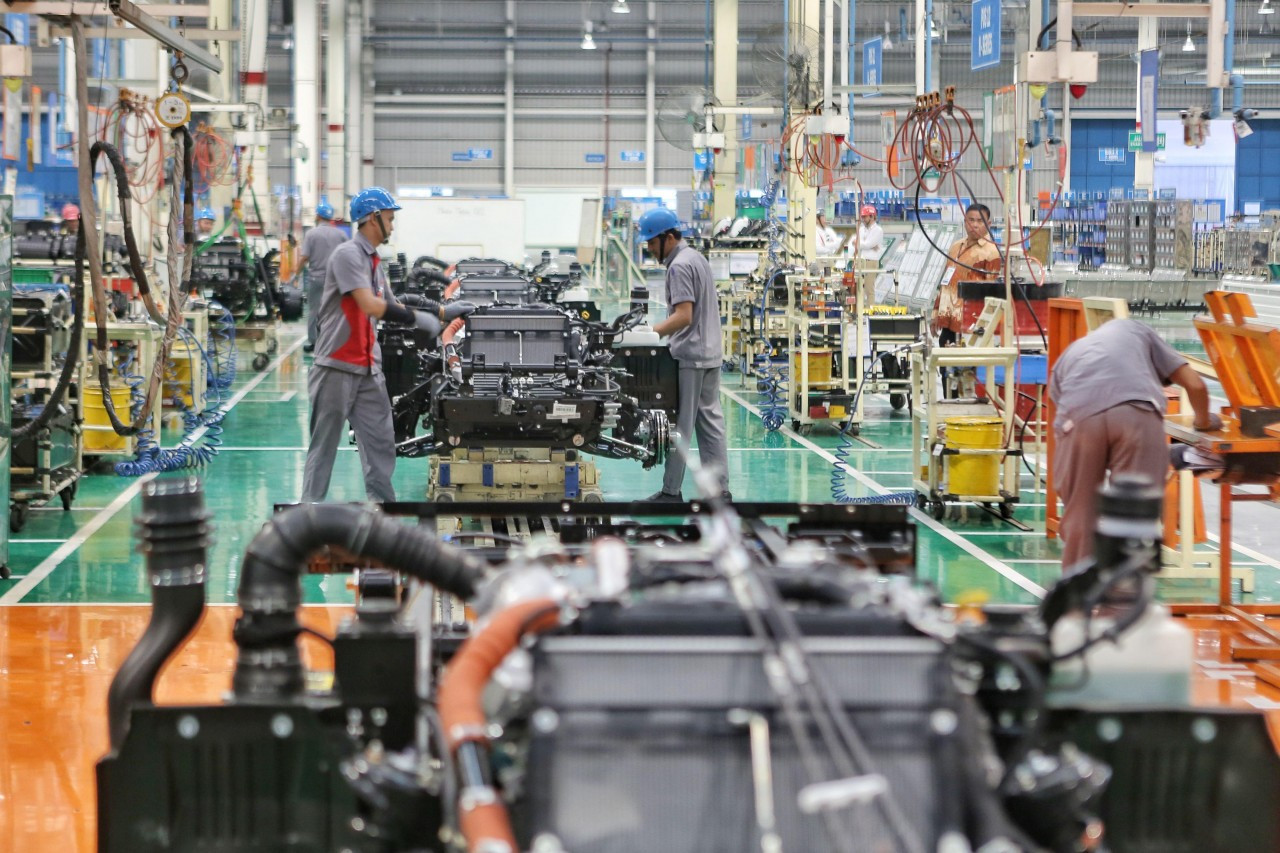 Workers assemble truck parts at a factory in East Karawang, West Java, in this undated file photo. (JP/Seto Wardhana)
S
tandard theories of structural economic transformation predict that the manufacturing sector’s share of the economy will increase as income per capita rises. Over time, the economy grows persistently with manufacturing serving as the main engine of growth, generating higher income per capita, increased spending on durable goods and greater capital accumulation.
However, recent data show that the manufacturing sector’s role in the economy is declining in several Southeast Asian countries, for example, Indonesia, Thailand, Malaysia and Singapore, with Vietnam as an exception. So, the conceptual prediction and empirical evidence seem contradictory. Why? And what does this mean for Indonesia?
Several factors may explain the decline in the manufacturing contribution to the economy.
First, modern manufacturing firms increasingly provide services as well as goods, particularly after-sales services. For example, when people buy a car, they care not only about owning the vehicle but also about the availability and quality of after-sales service. So, manufacturing more products will drive services.
Second, from the consumer perspective, preferences are shifting toward accessing services rather than owning durable goods. People increasingly opt to use the services that durable goods provide instead of buying the goods themselves. For example, consumers can enjoy a car’s benefits without owning it by using per-trip ride-hailing, short-term rentals or longer-term subscription plans billed monthly or yearly.
Third, younger consumers, particularly Gen Z and cohorts after them, prioritize spending on experiences rather than buying goods. They prefer to spend on travel and related activities, which supports tourism-related businesses such as hotels and restaurants, transportation and leisure services.

As a result, services may grow faster than manufacturing. This can reflect a normal structural transformation driven by rising consumer demand for services and experience-based spending. In such cases, a shift toward a service-led economy is a healthy development, since services tend to expand more quickly than manufacturing, which focuses on producing physical goods.
Conversely, some analysts argue that a sustained, widespread decline in manufacturing’s share of output and employment should be regarded as deindustrialization.
Indonesia economic growth pattern
Economic growth across sectors in Indonesia over the past 15 years has not been evenly distributed. Several sectors have experienced strong growth driven by changes in consumer behavior that prioritize experience-based consumption, especially after the COVID-19 pandemic. These sectors include accommodation and food and beverages, other services, particularly entertainment services, as well as transportation and warehousing.
For the transportation and warehousing sector specifically, growth has been driven not only by increased mobility of people but also by greater movement of goods caused by an expanding manufacturing sector and higher e-commerce activity.
Another rapidly growing area driven by changing consumption patterns is information and communication, particularly digital platforms and services, which is accelerating demand for online content, e-commerce, fintech and telecom services. An expanding domestic market, surging data traffic and advances in artificial intelligence are sustaining growth across the telecom ecosystem.
In addition, the manufacturing sector’s contribution to GDP remains substantial, 19.1 percent in 2025, but its growth has lagged behind national GDP growth, causing its share of GDP to decline over the past 15 years. Nevertheless, the sector continues to be an important employer, absorbing 19.6 million workers as of February 2025.
Further, investigation into the manufacturing sector shows varied growth performance when examined at the subsector level. Export-oriented industries, such as electronics, garments, footwear, leather goods and furniture, gained strong momentum in the past two quarters in 2026, driven by a recovery in global economic growth and the trade tensions between the United States and China.
Note that export-oriented industries are somewhat problematic. Many believe these industries are declining because Indonesia has lost its comparative advantage: production costs, especially wages, have risen faster than productivity. However, labor-intensive industries still make a significant contribution to exports and absorb a substantial share of the workforce. For these reasons, we should pay more attention to reindustrializing these manufacturing sectors.
Meanwhile, other domestically oriented industries also grew strongly, supported by robust demand momentum. These include machinery, transport equipment, food and beverages, chemicals and pharmaceuticals. A continuously expanding domestic market presents opportunities for growth for these domestically focused industries.
Some manufacturing subsectors, rubber, tobacco and paper, have shown weak growth due to falling productivity, raw material shortages and limited land. Oil and gas refinery also face structural headwinds from small domestic reserves and inadequate refining capacity. The basic metals sector, especially nickel, is pressured by restrictions on ore mining quotas.
Another important sector that has shown weak growth over the last 15 years is agriculture. It remains a crucial pillar of Indonesia’s economy, contributing 13.1 percent of national GDP in 2025 and continuing to absorb a large share of the labor force, 41.2 million workers as of February 2025. Highlighting both its enduring economic importance and the urgency of policies that raise productivity, diversify crop and vegetable production, and support rural incomes, so that growth in the sector can better contribute to inclusive national development.
Looking ahead, policy should target Indonesia’s most promising sectors to accelerate growth.
First, high‑growth activities tied to new consumer preferences for experience‑based spending, such as hotels and restaurants, transportation, information and communication, as well as leisure services, should be supported.
Second, the manufacturing sector remains essential because it generates high value‑added, contributes substantially to output and absorbs large numbers of workers.
Third, agriculture must not be overlooked. It is the largest employer and Indonesia’s tropical climate offers strong opportunities to expand production of grain, crops, fruit, vegetables and other agricultural goods.
*****
The writer is head of industry and regional research at Bank Mandiri.