The Jakarta Post
Please Update your browser
Your browser is out of date, and may not be compatible with our website. A list of the most popular web browsers can be found below.
Just click on the icons to get to the download page.


Popular Reads
Top Results
No results found. Please check your search term and try again
Can't find what you're looking for?
View all search results
Popular Reads
Top Results
No results found. Please check your search term and try again
Can't find what you're looking for?
View all search resultsThe waste reform Indonesia is missing
While Indonesia is making massive investments in the downstream sector, upstream reforms regarding waste collection, financing and management must align with that ambition.
Change text size
Gift Premium Articles
to Anyone
Share the best of The Jakarta Post with friends, family, or colleagues. As a subscriber, you can gift 3 to 5 articles each month that anyone can read—no subscription needed!
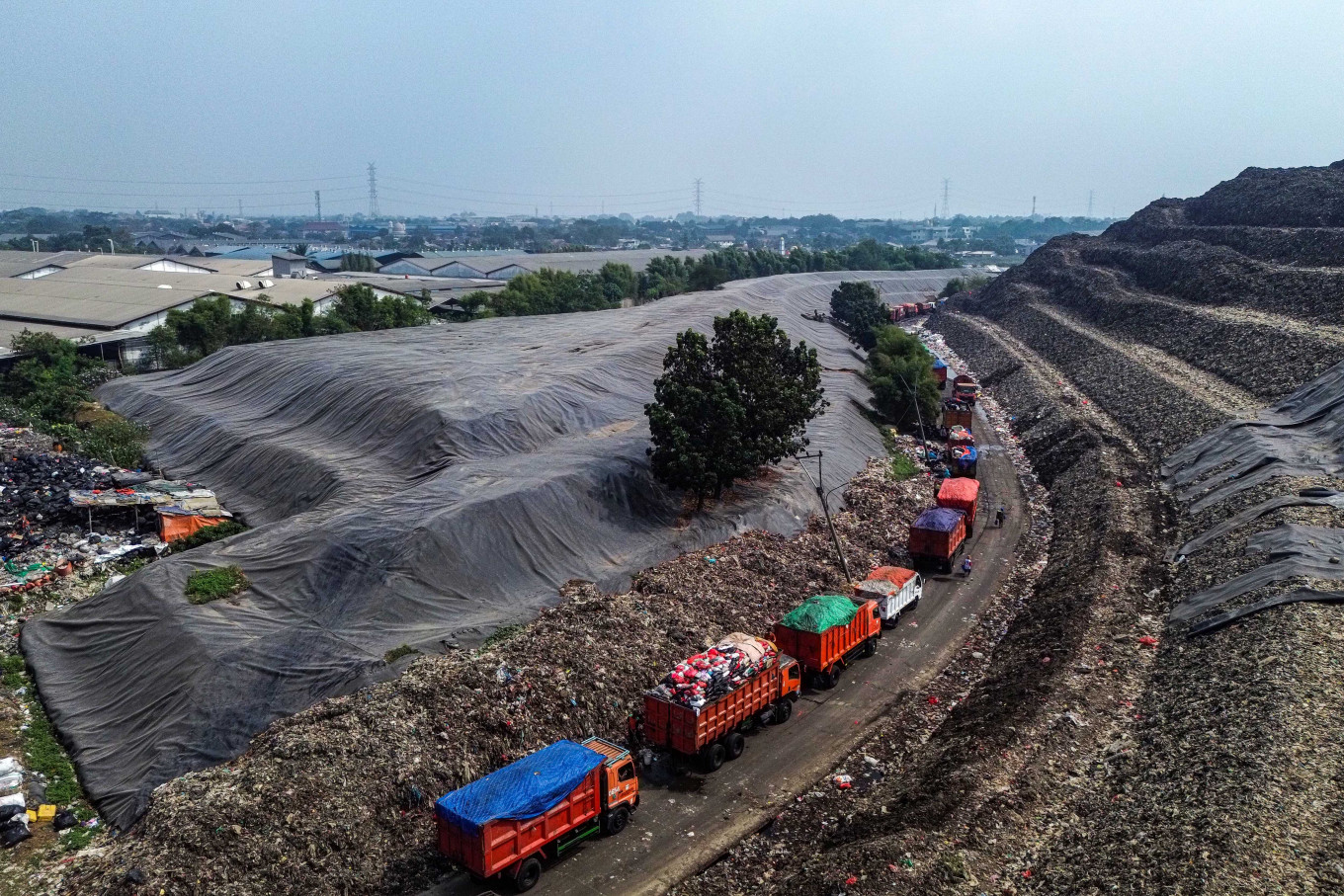 An aerial photo shows garbage trucks queueing near mounds of waste covered with protective sheeting at the Bantar Gebang landfill in Bekasi, West Java, on Aug. 2, 2026. (Antara/Darryl Ramadhan)
I
ndonesia is pinning high hopes on converting waste into electricity. State asset fund Danantara has begun construction of the country's first waste-to-energy plant in Denpasar, Bali, and a second broke ground in Bekasi, West Java, just last month. Plans call for approximately 30 similar facilities nationwide. It is a bold move in response to a genuine emergency, and implementation has moved quickly.
However, this major initiative in the downstream sector will only yield results if matched by similar efforts upstream. The Environment Ministry has acknowledged that these facilities will address only about 13 percent of the waste produced. The reality is that we are striving to build modern, 21st-century cities while still managing waste much as we did a century ago, and no matter how sophisticated downstream technology, it cannot make up for failures in upstream management.
When waste is properly sorted at the household level, new waste-to-energy facilities receive the higher-quality input needed for efficient operation, while recyclable and organic materials can be repurposed rather than left to rot. This is the foundation of a circular economy, a significant economic opportunity for Indonesia. It could also pave the way to formal employment for millions of people who currently sort and collect waste informally.
The National Development Planning Board (Bappenas) estimates that failing to realize this could cost the nation Rp 593 trillion (US$33.6 billion) to Rp 638 trillion in GDP by 2030, equivalent to 2.3 to 2.5 percent of the economy.
The IBC suggests the potential for even greater returns. Its analysis projects a return of Rp 4.61 for every rupiah invested in circular economy-based waste management by 2045, a ratio far superior to the estimated 2.4 ratio for the high-speed rail project in the United Kingdom.
Ultimately, however, realizing this opportunity hinges on governance, specifically how institutions organize, fund and oversee the waste management system.

A cycle of mistrust and an underfunded system
In practice, weak governance locks households and local government into a cycle of mistrust. Households see collection as unreliable and are therefore reluctant to pay proper fees. Local governments see low payment rates and hold back investment. As a result, service quality remains poor and mistrust deepens.
A chronic funding shortage sustains the cycle. On average, local governments allocate only 0.7 percent of their annual budgets to waste management, far below the roughly 5 percent benchmark. Where fees are collected, the process is often informal, handled by local neighborhood administrators.
Even in Jakarta, one of Indonesia’s most developed cities, these fees remain entirely outside the municipal financial system and are not linked to the services they are intended to fund. Since these fees are rarely earmarked for waste management (ring-fenced), the money can flow to other priorities.
The reforms that pay off
The problems themselves are well understood. They fall into three areas, which are institutions that do not align with their intended functions, services that are not designed with the served community in mind and a lack of regulatory enforcement. Each problem has its own corresponding solution.
The first is institutional structure. In most regions, environmental agencies are responsible for both setting regulations and providing services. They act as both player and referee. When the referee also plays the game, there is no one left to blow the whistle on infractions. City governments should delegate waste management to a dedicated entity, such as a public service unit, a regional government-owned enterprise or a private partner, so that oversight is separated from service delivery and generated revenue is managed independently.
The second concerns service model and payment mechanisms. Waste management is complex, but many cities still rely on a rudimentary, one-size-fits-all model approach without regard for local capacity or conditions. Cities should select the most suitable model, whether the service is managed directly by the government, outsourced to third parties under contract or operated through partnerships involving the community and private operators.
Payment systems need the same attention. At a time when residents live increasingly digital lives, waste management bills are still frequently delivered manually, and that is assuming they reach the residents at all. Integrating waste management fees into existing utility bills and providing digital payment channels would make the billing process far simpler and more reliable. Bogor in West Java shows what this approach can achieve. By integrating waste fees into water bills, the city collected approximately Rp 15 billion and raised its cost-recovery rate.
The third is the practical application of regulations. Indonesia has no shortage of regulations, but what is written does not always reflect the reality on the ground. Enforcement would improve if responsibilities were clearly defined, so that every property and neighborhood has a designated party responsible for its waste, as in Shanghai, China.
Local governments also need support and recognition when they fulfill their duties. Transfer from the central government to local governments should therefore come with technical guidance where needed and be tied to measurable outcomes, rather than disbursed regardless of performance.
Opening the door to private capital
Get these conditions right, and waste management becomes financially viable. Private companies can then participate with confidence, bringing capital, operational discipline and innovation.
Morocco offers a tangible example. Morocco faced the same overlap between regulatory and operational roles that Indonesia now confronts. It separated oversight functions from operations, enacted dedicated waste legislation, and allowed private companies to compete for service contracts. Waste collection coverage rose from 40 percent to 96 percent, and the share of services handled by private operators grew from 44 percent to 86 percent. These reforms did not drive businesses away; on the contrary, they attracted their interest. They bought it in.
This is the opportunity before Indonesia. The private sector is ready to do more, from financing infrastructure to running collection and recycling activities. Companies need clear institutional frameworks, revenue certainty and consistently enforced regulations. The rapid push to develop waste-to-energy technology has proven that Indonesia can move quickly when there is strong will. Now, the task is to bring that same determination to the upstream sector so that ongoing investments can yield maximum results. That is how we can build cleaner cities and a more resilient circular economy.
*****
The writer is the principal for policy and program at the Indonesian Business Council (IBC).