The Jakarta Post
Please Update your browser
Your browser is out of date, and may not be compatible with our website. A list of the most popular web browsers can be found below.
Just click on the icons to get to the download page.


Popular Reads
Top Results
No results found. Please check your search term and try again
Can't find what you're looking for?
View all search results
Popular Reads
Top Results
No results found. Please check your search term and try again
Can't find what you're looking for?
View all search resultsGetting social assistance targeting right
Recent public complaints from households that have found themselves inadvertently misclassified is not a reason to abandon the data-driven DTSEN system, but an opportunity to refine it to improve targeting effectiveness.
Change text size
Gift Premium Articles
to Anyone
Share the best of The Jakarta Post with friends, family, or colleagues. As a subscriber, you can gift 3 to 5 articles each month that anyone can read—no subscription needed!
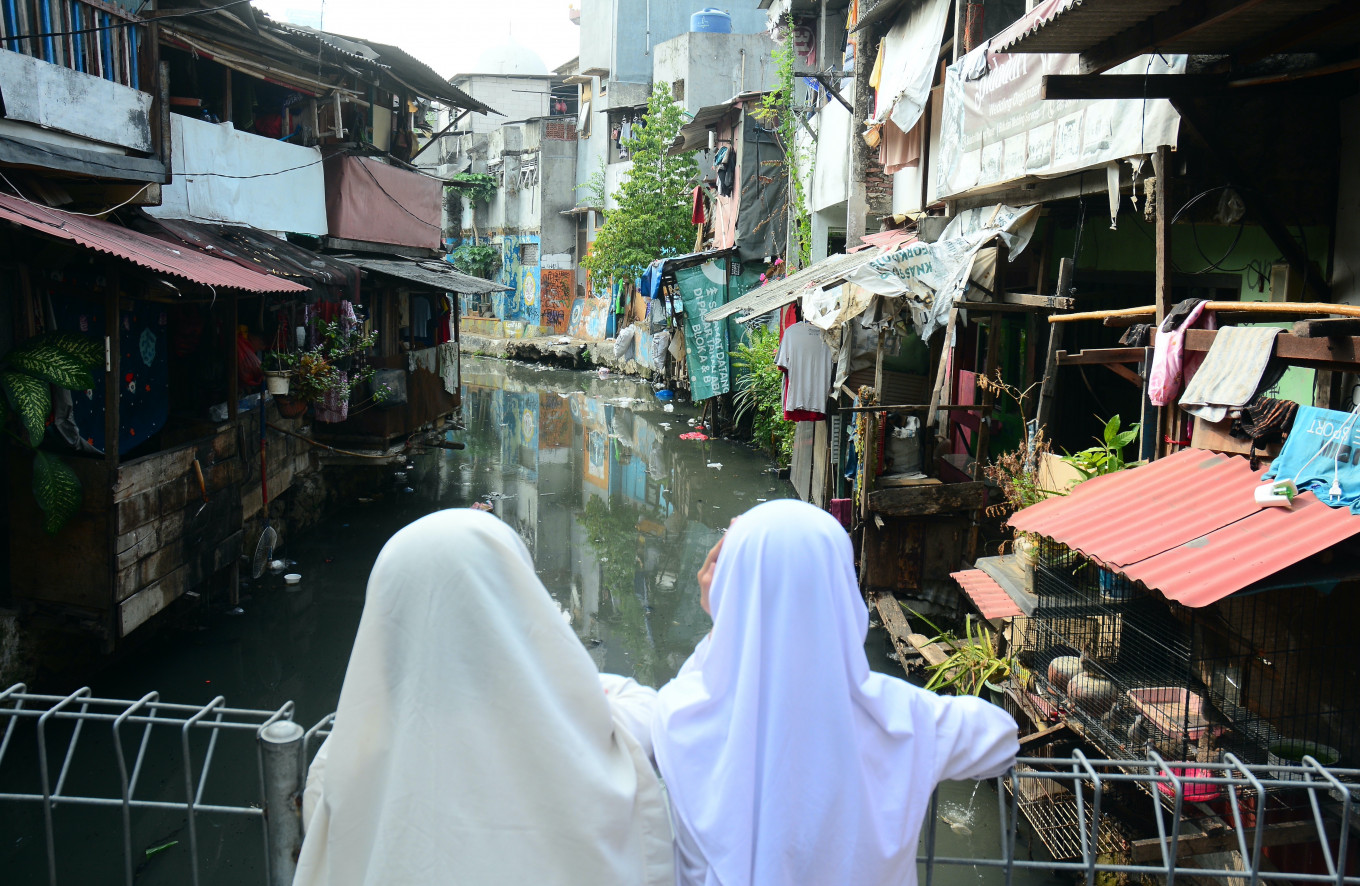 Two schoolgirls look at an informal riverbank settlement on Aug. 7, 2026, from a bridge in Kebon Melati village, Tanah Abang, Central Jakarta. (JP/Iqro Rinaldi)
I
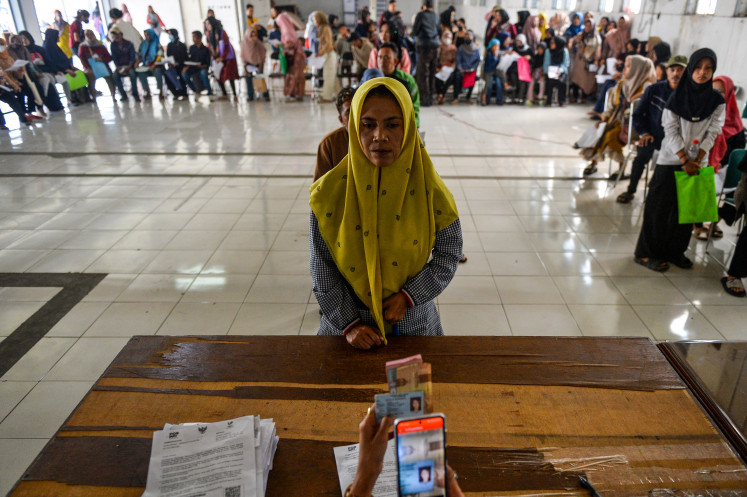
n recent weeks, social media has been filled with recurring complaints from families who consider themselves financially stretched but have found themselves classified in deciles 9 or 10, the highest categories in the National Socioeconomic Single Data (DTSEN) system. As a result, they may have lost access to many social assistance programs, including the KIP Kuliah scholarship program.
Our analysis of National Socioeconomic Survey (Susenas) microdata suggests a more nuanced explanation: Many of these cases are predictable consequences of how targeting systems work.
Challenge of targeting
The government has allocated around Rp 508.2 trillion (US$28.8 billion) for social protection in 2026, while subsidies and compensation for state-owned enterprises selling products below market prices had reached Rp 233 trillion in the first half of the year alone.
Yet large spending does not automatically mean accurate targeting. More than one-third of households in the highest expenditure group still use subsidized 3-kilogram cylinders of liquefied petroleum gas (LPG), while around one-third of the very poorest households received no social assistance in 2025.
The challenge is not simply how much the government spends, but how effectively support reaches those who need it most.

Ideally, eligibility would be based on income. But with roughly six in 10 workers in informal employment, income is difficult to verify. Meanwhile, detailed expenditure data are available only through sample surveys, like the Susenas.
A proxy means test (PMT) estimates household welfare from observable characteristics such as housing, assets, education, occupation and household demographics. It offers a practical compromise between accuracy and nationwide coverage, and the country has used the approach since 2008.
Indonesia is not alone in relying on PMT. Other developing countries, including Chile, Mexico, Colombia, the Philippines and Pakistan, have used similar approaches. More recently, the global direction has shifted toward combining statistical scoring with administrative data, regular updating and verification mechanisms.
The World Bank’s 2022 reassessment emphasizes that no single targeting method fits every context; rather, systems should combine approaches based on program objectives and administrative capacity.
Chile and Pakistan, for example, have moved toward more dynamic social registries that integrate administrative records with mechanisms for updating and verification. DTSEN is broadly moving in the same direction through records linked to the national identification number (NIK), regular updates and suggestion/complaint channels.
No statistical model can fully capture a family’s living standard.
When we recreated a simplified PMT using 343,000 households in the March 2025 Susenas, it explained only a little over half of the welfare differences observed across households. Using the stringent benchmark of an exact decile match, only around one in four households were placed in the same decile as indicated by their actual expenditure.
Some targeting errors are therefore inherent in estimating welfare from limited observable information, not simply implementation failures.
Thin line between deciles
Indonesia’s welfare distribution makes this challenge more sensitive. Household expenditure is tightly clustered in the middle: from around deciles 3 to 7, the distance between adjacent groups is only 10-14 percent on our estimated welfare score. Small changes in recorded characteristics can therefore produce large movements in ranking.
In one simulation, holding all other households unchanged, a decile 2 household whose records were updated to show ownership of a motorcycle and an air conditioner moved to decile 5, placing it outside the assumed eligibility range of some subsidies. When families feel their circumstances are not very different from neighbors placed several deciles away, that perception may be reasonable.
The same pattern is visible through a consumer-class lens.
Based on our framework using World Bank definitions, a household moves beyond the “vulnerable” category at 1.5 times the poverty line (PL), or around Rp 31,000 per person per day, and is considered middle class only at 3.5 times the PL, or roughly Rp 71,000 per person per day.
The entire climb from escaping vulnerability to reaching the middle class thus spans just Rp 40,000 per day per person. And within that corridor, which stretches from roughly from the 33rd to the 83rd percentile, live some 142 million Indonesians, or half the population that make up the aspiring middle class.
This means many program eligibility thresholds fall within the most densely populated part of the welfare distribution, where households just above and below the cutoff may differ very little in economic terms.
Deciles are also relative rankings. A family’s position can change even when its circumstances do not, simply because other households are updated and the overall ranking shifts. This makes consistency and timely updates especially important.
Better data, better targeting
This is why the government’s move toward DTSEN deserves support. By consolidating overlapping databases, matching records with NIK, expanding coverage and introducing regular updates, the new system provides a stronger foundation for social program targeting. It also aligns with the global shift toward combining statistical scoring, administrative data and verification rather than relying on a single method.
Decile rankings should therefore remain an important input for targeting, while complementary verification and correction mechanisms support final eligibility decisions.
Operationally, four areas deserve attention to improve targeting effectiveness.
First, eligibility decisions should combine statistical ranking with field verification and a functioning appeal mechanism. Second, updates should be synchronized nationally, because partial updates can shift households whose data have not changed.
Third, households moving beyond a program threshold should enter a transition period rather than lose benefits immediately, with support continuing until verification is complete.
Fourth, the system should respond more quickly to verified shocks, such as layoffs or the death of a breadwinner, allowing affected households to enter support programs without waiting for the next regular reassessment.
DTSEN is a public asset worth strengthening. The debate over deciles is not a reason to retreat from data-driven targeting but an opportunity to make the system more accurate, adaptive and trusted. The model's sophistication matters less than the outcome: fewer vulnerable families left outside the gate, and fewer benefits flowing to those who no longer need them.
*****
The writer is an analyst at the Mandiri Institute.