The Jakarta Post
Please Update your browser
Your browser is out of date, and may not be compatible with our website. A list of the most popular web browsers can be found below.
Just click on the icons to get to the download page.


Popular Reads
Top Results
No results found. Please check your search term and try again
Can't find what you're looking for?
View all search results
Popular Reads
Top Results
No results found. Please check your search term and try again
Can't find what you're looking for?
View all search resultsThe 2027 State Budget: Path toward a narrower deficit
Tax revenue in 2027 is projected at around 9.3 percent of GDP. Adding customs and excise raises the ratio to roughly 10.4 percent, slightly above 10.2 percent of GDP in the 2026 outlook.
Change text size
Gift Premium Articles
to Anyone
Share the best of The Jakarta Post with friends, family, or colleagues. As a subscriber, you can gift 3 to 5 articles each month that anyone can read—no subscription needed!
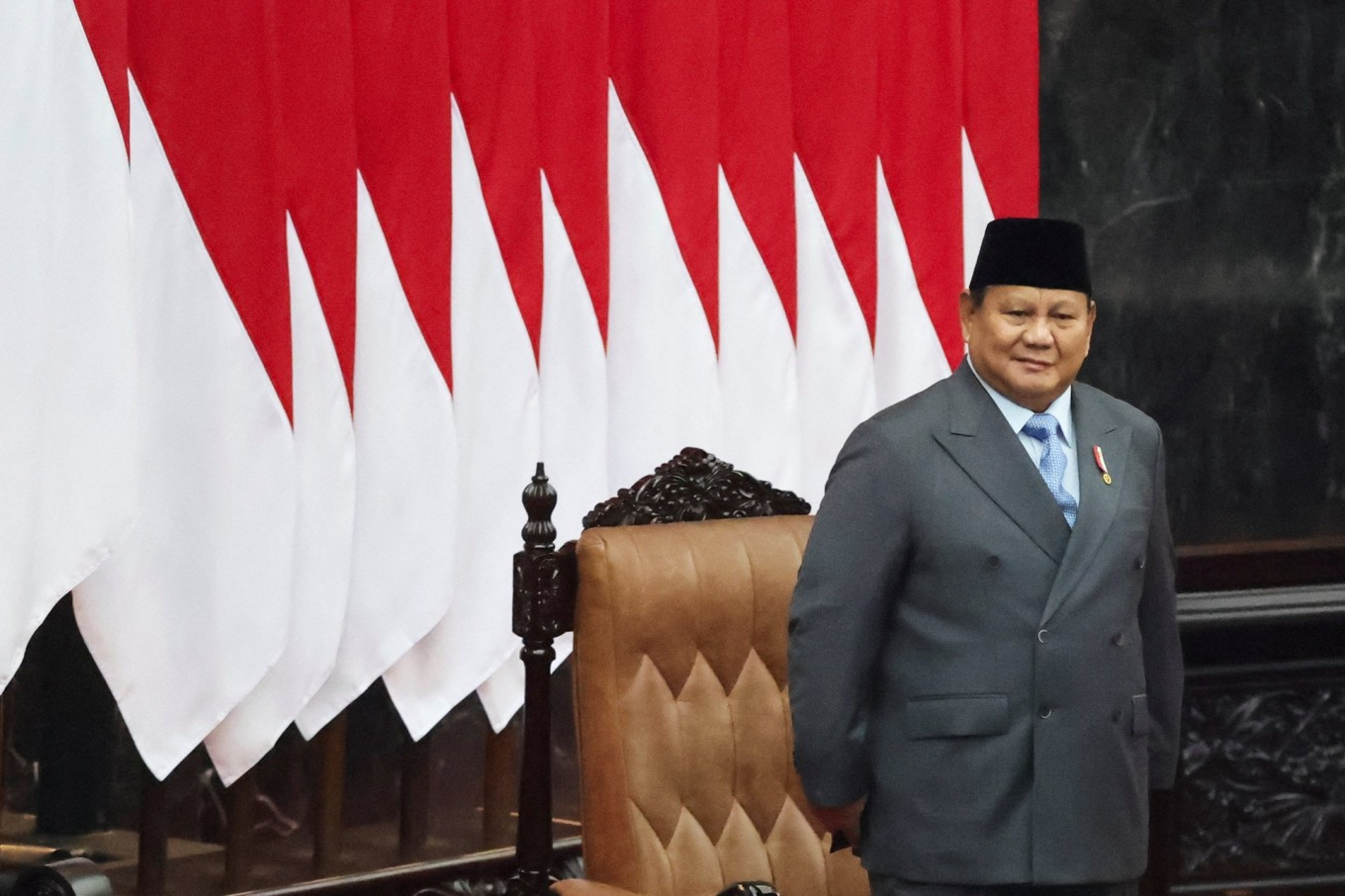 President Prabowo Subianto looks on as he arrives on Aug. 14 at the Senayan legislative complex in Central Jakarta for the People's Consultative Assembly (MPR) plenary meeting, in which he delivered the State of the Nation address and the 2027 state budget proposal. (Reuters/Stringer) (Reuters/Stringer)
T
he draft of the 2027 State Budget makes a clear headline commitment, with the fiscal deficit set to narrow to 2.4 percent of GDP, from 2.85 percent in the 2026 outlook, while the primary balance moves closer to neutral.
This consolidation rests heavily on revenue. Tax revenue is targeted to grow 12.1 percent to Rp 2.6 quadrillion (US$146.5 billion), while taxation as a whole is set at Rp 2.9 quadrillion, up 10.5 percent from the 2026 outlook. With non-tax revenue set to decline as state-owned enterprise (SOE) dividends are shifted to state asset fund Danantara, the credibility of the narrower deficit will depend largely on tax collection.
Tax revenue in 2027 is projected at around 9.3 percent of GDP. Adding customs and excise raises the ratio to roughly 10.4 percent, slightly above 10.2 percent of GDP in the 2026 outlook. Thailand collected around 13.1 percent of GDP in 2025, while the Philippines and Malaysia collected 14.6 percent and 12.8 percent, respectively.
Indonesia has remained in the 9 to 10 percent range for most of the past decade.
The composition of the target also warrants attention. Other tax components are budgeted at Rp 159 trillion in 2027, more than fifteen times the Rp 7 to 17 trillion range collected before 2025. Much of the recent increase reflects the tax deposit mechanism introduced under Coretax, alongside tax administration and collection receipts, rather than simply a structural expansion of the taxpayer base. Tax deposits allow taxpayers to pre-fund future liabilities, although unused balances do not yet constitute state revenue.
Other jurisdictions use different mechanisms. Vietnam requires quarterly provisional Corporate Income Tax payments of at least 80 percent of the annual liability, while Thailand requires a half-year prepayment based on estimated annual profit through Form Half-Year Corporate Income Tax Return (PND) 51. These are mandatory estimate-based instalments rather than standing deposits. Deposit-related receipts could therefore make headline revenue growth less informative about the recurring tax base.

Tax buoyancy reinforces the challenge. It measures how strongly tax revenues respond to economic growth, with a coefficient above 1 indicating that revenues grow faster than GDP. Before the pandemic, Indonesia’s realized tax buoyancy averaged reached around 0.7 in 2014-2019, before rising to around 2 during the 2022 commodity boom and falling back below 1 through 2025.
Outside exceptional commodity-driven periods, this suggests that Indonesia’s tax base has historically responded less than proportionately to economic growth. The 2027 budget target implies tax buoyancy of around 1.2, materially above recent non-commodity-boom performance. Reaching that level would require tangible gains in administration and compliance, making revenue mobilization one of the key factors shaping the delivery of the 2027 fiscal consolidation.
Several structural factors help explain Indonesia’s lower tax ratio relative to regional peers.
First, Indonesia has a relatively narrow consumption-tax base, partly reflecting its high value-added tax (VAT) registration threshold of Rp 4.8 billion or around $275,000, compared with roughly $50,000 in Thailand and a broadly similar level in the Philippines.
Second, Indonesia raises relatively little revenue from property taxation, at only around 0.1-0.2 percent of GDP, versus around 0.4-0.6 percent in Thailand and the Philippines and roughly 1-2 percent across Organisation for Economic Cooperation and Development (OECD) economies.
Third, tax expenditure is projected to reach Rp 632 trillion in 2027, nearly double its 2022 level, with around 65 percent concentrated in VAT and luxury-goods tax incentives, even as VAT and luxury-goods tax revenue is targeted to grow 13.4 percent year-on-year.
Together, these factors point to a relatively narrow effective revenue base.
Structural constraints are only part of the story. The domestic operating environment also affects how quickly potential revenue translates into collection.
Coretax has raised the potential for stronger tax administration and compliance, but implementation remains uneven, while the sensitivity of VAT receipts to refund realization was evident in the 2025 contraction.
A 2025 assessment by the United Nations Development Program (UNDP) put Indonesia’s informal economy at around 36 percent of GDP, leaving a sizeable share of activity outside the formal reporting and tax perimeter. Enforcement capacity has yet to keep pace with the growing compliance workload, while implementation of the Amended Common Reporting Standard (CRS) and Crypto-Asset Reporting Framework (CARF) will depend on complementary regulation, data integration and sufficient audit capacity.
None of these weakens the case for fiscal consolidation. A narrower deficit would strengthen fiscal buffers, while stronger revenue mobilization would generally preserve more room for infrastructure and social programs than an adjustment driven mainly by spending restraint.
The 2027 framework nevertheless brings longstanding tax-policy questions into sharper focus. The growing cost of tax expenditure comes alongside the need to broaden the revenue base, while property taxation remains relatively underutilized and the interaction of refunds and tax deposits makes the composition and timing of revenue increasingly important. Better transparency, stronger tax administration and improved international information exchange would make it easier to assess whether higher revenue reflects lasting improvements in tax collection or only temporary factors such as payment timing and refunds.
The 2027 deficit target will depend not only on the headline numbers, but also on how sustainable the revenue increase is. A broader tax base, stronger compliance and better administration would make the improvement more durable. In this sense, 2027 will test whether Indonesia can raise revenue on a more lasting basis while keeping the deficit lower.
*****
The writer is an economist at Bank Mandiri.