The Jakarta Post
Please Update your browser
Your browser is out of date, and may not be compatible with our website. A list of the most popular web browsers can be found below.
Just click on the icons to get to the download page.


Popular Reads
Top Results
No results found. Please check your search term and try again
Can't find what you're looking for?
View all search results
Popular Reads
Top Results
No results found. Please check your search term and try again
Can't find what you're looking for?
View all search resultsUneven demand amid Indonesia’s automotive recovery
Government programs, like the free nutritious meal initiative and Red and White Cooperatives, have helped drive commercial vehicle demand, but the boost may prove difficult to sustain.
Change text size
Gift Premium Articles
to Anyone
Share the best of The Jakarta Post with friends, family, or colleagues. As a subscriber, you can gift 3 to 5 articles each month that anyone can read—no subscription needed!
 Set as preferred source
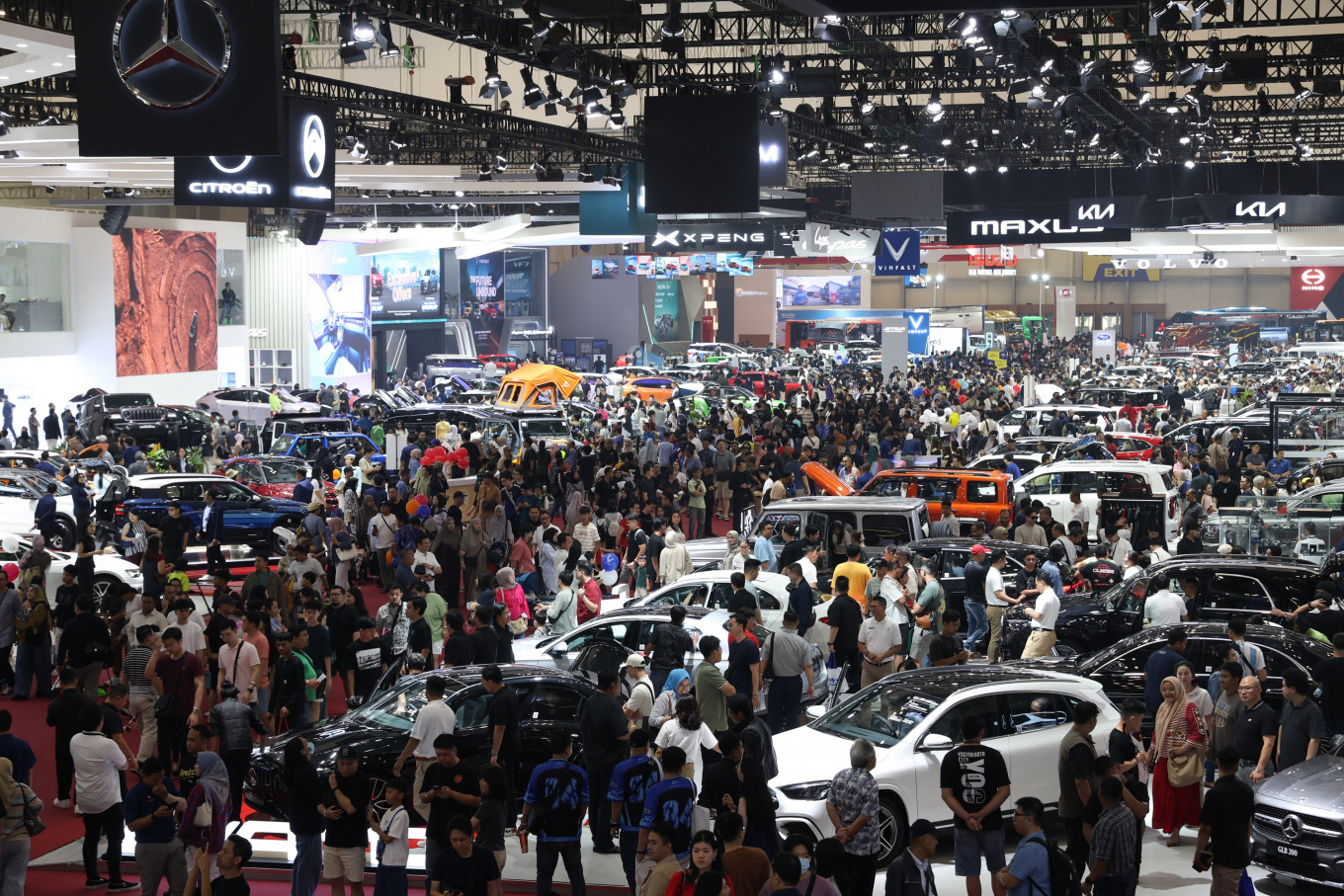 Visitors crowd the 2025 Gaikindo Indonesia International Auto Show (GIIAS) at the Indonesia Convention Exhibition in BSD City, Tangerang, Banten, in this undated photo. The event drew a total of 485,569 visitors over its 11-day run from July 24 to Aug. 3. (Courtesy of/GIIAS 2025)
I
ndonesia’s automotive industry entered 2026 with a rebound after a hard year in 2025. At first glance, the numbers look convincing. Wholesale vehicle sales reached 517,742 units cumulatively from January to July this year, up 18.3 percent from the same period in 2025. After two difficult years, the return to double-digit growth is encouraging.
However, the headline number deserves a more detailed look.
The growth in car sales is not yet strong evidence that Indonesian household purchasing power has recovered. The most important details are in the composition of sales. Passenger vehicle sales increased by 11.3 percent year-on-year in the first seven months of 2026, while commercial vehicle sales grew by 43.1 percent.
The significant growth in commercial cars is driven by pick-up and truck products. This has resulted in a noticeable shift in the composition of the market.
Over the past three years, commercial vehicles have generally accounted for around 22-23 percent of national vehicle sales, but in the first half of 2026, their share increased to 26.8 percent. This suggests that a significant part of the current automotive rebound is being driven by business and institutional demand rather than household consumption.
The difference between wholesale and retail sales also deserves attention. Wholesale sales have risen strongly, while retail sales have grown at a more moderate pace. This means that the increase in vehicle deliveries from manufacturers to dealers has not yet been matched by equally strong purchases from end consumers. The gap is not necessarily a negative signal, but it does suggest that wholesale growth alone should not be treated as direct evidence of a strong recovery in consumer purchasing power.

Government programs have been among the main factors supporting commercial vehicle demand. Programs such as free nutritious meal initiative and Red and White Cooperatives have created additional transportation and distribution needs. The free meals program, for example, requires logistics support for its kitchens, and the Indonesian Automotive Industry Association (Gaikindo) has acknowledged its contribution to rising light commercial vehicle sales.
These programs are clearly positive for vehicle demand, but the important point is that this demand is largely policy-driven rather than the result of a broad recovery in household consumption.
Commercial vehicle sales have also benefited from stronger activity in the logistics sector. The expansion of distribution networks, delivery services and broader transportation needs has supported demand for light commercial vehicles and trucks. This provides another source of growth beyond government-related demand. However, these supporting factors may not continue at the same pace indefinitely, particularly once the initial logistics requirements associated with current programs have largely been fulfilled.
The passenger-car is somewhat different from the commercial car. First, current growth is partly supported by a low based effect, as this year’s performance is being compared with a very weak market in 2025. Passenger-car sales fell to around 613,000 units last year, down 8.9 percent from 2024 and representing the weakest annual performance since the pandemic-era collapse in 2020. With such a low comparison base, even a moderate recovery can generate a relatively strong year-on-year growth rate, although underlying consumer demand has not yet fully normalized.
Second, the improvement in passenger vehicle sales appears to be driven more by stronger competition in the market than by a significant recovery in household purchasing power. The rapid expansion of Chinese manufacturers has introduced more new models at increasingly competitive prices, prompting other automakers to respond with better features and more attractive pricing.
As a result, consumers now have more affordable and appealing options than before. This has helped support vehicle sales, but it should not be interpreted as clear evidence that consumer purchasing power has strengthened significantly.
Looking ahead, automotive sector could face a more challenging second half of 2026.
First, the increasing of Bank Indonesia’s benchmark rate may also increase borrowing costs and monthly installments, which could weaken passenger vehicle demand.
Second, unclear outlook for mining production quotas could limit mining activity and truck demand.
Third, tighter governance of the free meals program has led to the closure of several kitchens, potentially reducing additional vehicle requirements for its logistics network.
Lastly, impact of Red and White Cooperatives may also be less supportive for domestic manufacturers, as a significant portion of its vehicle procurement relies on imported units.
More importantly, much of the additional demand generated by government programs is likely to be one-shot in nature. The free meals program and Red and White Cooperatives require vehicles to establish their logistics networks, but once these initial fleet requirements have been met, the same level of purchases is unlikely to be repeated every year.
Together with the fading low based effect from weak sales in 2025, this creates a risk that automotive growth could lose momentum. In a weaker scenario, sales could decline, while even under a more favorable scenario, growth may become more moderate.
The next phase of Indonesia’s automotive recovery will depend increasingly on household demand. Government support remains important, the government has indicated that new incentives for electric vehicles will be introduced in the second half of 2026, although the details remain unclear. Ideally, these incentives should be designed more fairly and reach a broader range of consumers, helping sustain vehicle demand amid higher financing costs and global economic uncertainty.
However, incentives alone will not be enough. Household demand also needs to strengthen, as consumer purchasing power remains an important foundation for a sustainable automotive recovery. Policies that support real income, employment and affordable financing would help improve consumers’ ability and confidence to make large purchases. In the longer term, stronger household demand should become the main driver of vehicle sales, rather than temporary policy support or a low based effect.
*****
The writer is an industry and regional analyst at Bank Mandiri.