The Jakarta Post
Please Update your browser
Your browser is out of date, and may not be compatible with our website. A list of the most popular web browsers can be found below.
Just click on the icons to get to the download page.


Popular Reads
Top Results
No results found. Please check your search term and try again
Can't find what you're looking for?
View all search results
Popular Reads
Top Results
No results found. Please check your search term and try again
Can't find what you're looking for?
View all search resultsEurope's heatwaves expose insurance gap as business losses mount
Moody's has published estimates that last summer's European heatwaves cost 43 billion euros (US$50 billion) in lost economic output while generating only about 500 million euros of insured payouts.
Change text size
Gift Premium Articles
to Anyone
Share the best of The Jakarta Post with friends, family, or colleagues. As a subscriber, you can gift 3 to 5 articles each month that anyone can read—no subscription needed!
 Set as preferred source
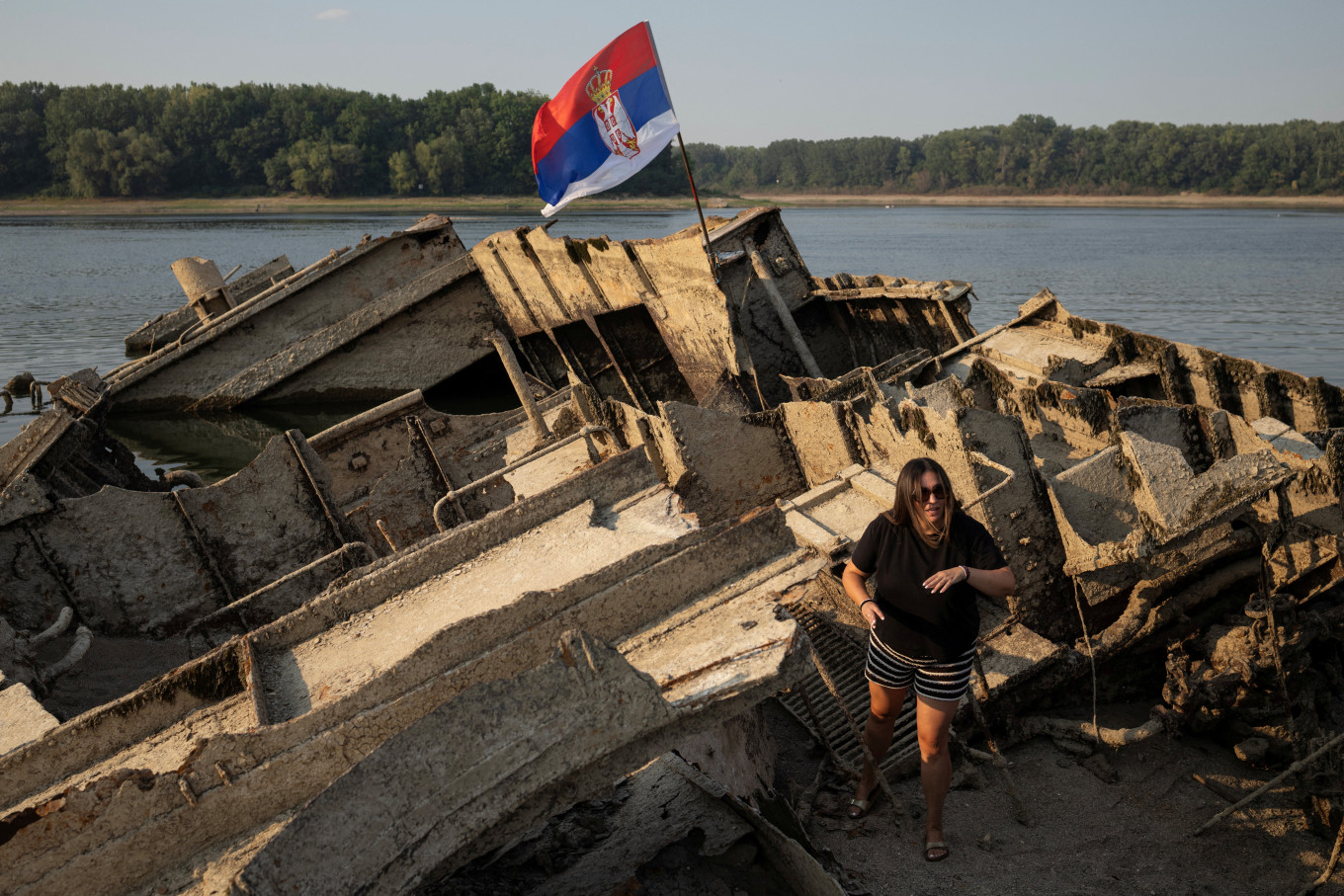 A woman stands on a sunken German warship from World War II, exposed due to low Danube river levels caused by drought and extreme heat near Prahovo, Serbia, on Aug. 13. 2026. (Reuters/Marko Djurica)
F
or more than a century, cafes in the Italian city of Padua have welcomed customers for an early evening drink, or aperitivo, encouraging them to sit outside and socialize before dinner.
As Europe bakes under its fifth heatwave of the year, the traditional 6-7 p.m. slot has all but disappeared as people seek air-conditioning indoors, cutting sales for many hospitality businesses.
Adding to the pressure, extreme heat often falls outside traditional business interruption insurance, exposing a growing protection gap for companies across Europe.
Moody's has published estimates that last summer's European heatwaves cost 43 billion euros (US$50 billion) in lost economic output while generating only about 500 million euros of insured payouts.
In Padua, aperitivo often now starts later, "which means that the outdoor seating areas, the terraces, the spaces outside [...] are left unused and empty," said Federica Luni, president of hospitality association APPE Padova.
According to a survey of about 600 hospitality businesses in the city and its province, more than 80 percent reported turnover declines of around 20 percent during the recent heatwave.

"A 20 percent decline wipes out your margin," Luni said.
Heatwaves are increasingly taking a toll on Europe's economy, reducing productivity, curbing consumer spending and raising operating costs. For insurers, such losses can be difficult to cover because they often stem from indirect operational disruption rather than property damage.
"Heat in itself is not a traditionally insured risk," said Swenja Surminski, managing director for climate and sustainability at Marsh.
"Extreme heat rarely causes catastrophic physical damage the way a flood or a storm does, but the financial operational disruption that it triggers can be just as severe."
A 2023 survey of 9,000 small and medium-sized firms for Europe's insurance regulator found 28 percent held business interruption cover as part of their property insurance, while 17 percent had nondamage business interruption protection covering events such as strike action.
The protection gap is widening as the economic costs of extreme heat mount. Trains are delayed, agricultural yields fall and factory cooling costs rise, while workers often struggle to maintain productivity during prolonged spells of extreme temperatures.
Companies that flagged a hit from hot weather or warned about its potential future impact when reporting second-quarter earnings included Swedish shop-fitting provider ITAB Group, Italian cement producer Buzzi and French payments firm Worldline.
Compound risk
Heat often acts as a compound risk, interacting with drought, wildfire and water shortages rather than triggering a single identifiable loss event. That makes it harder to model and insure than some other natural catastrophes.
The challenge is particularly acute in Europe, the fastest-warming continent. Reuters Climate Monitor showed the average temperature across Western Europe was nearly 10 degrees Celsius above the 1961 to 1990 average on Aug. 11.
Data compiled by environmental disclosure platform CDP showed 35 percent of companies it tracks identified heatwaves as a risk driver, led by businesses in manufacturing, services, infrastructure and food-related sectors.
While insurance may cover some physical losses linked to events such as power outages, businesses often say compensation does little to offset lost sales and reduced customer activity.
"The real loss is the revenue you don't make and the business activity that never takes place because of the outage," Luni said.
To bridge the gap, insurers are increasingly exploring parametric products that pay out automatically when temperatures exceed predefined thresholds. Unlike traditional indemnity-based insurance, such policies do not require a lengthy loss-adjustment process.
The European market for parametric insurance is expected to reach $7.93 billion by 2031, according to a report by KBV Research, with compound annual growth of 9.5 percent between 2025 and 2032.
Such policies are already being used in agriculture, where heat can reduce crop yields or livestock productivity, and industry experts see scope for expansion into sectors including transport and workforce protection.
"Parametric insurance can really play a role," said Aidan Kerr, head of UK and Ireland public sector solutions at Swiss Re.
Even so, many companies will need to focus primarily on adapting their operations to withstand more frequent periods of extreme heat through measures such as investing in cooling technologies, redesigning workplaces and stress-testing supply chains, Marsh's Surminski said.
"Take action to avoid the losses rather than address them once they've occurred."