The Jakarta Post
Please Update your browser
Your browser is out of date, and may not be compatible with our website. A list of the most popular web browsers can be found below.
Just click on the icons to get to the download page.


Popular Reads
Top Results
No results found. Please check your search term and try again
Can't find what you're looking for?
View all search results
Popular Reads
Top Results
No results found. Please check your search term and try again
Can't find what you're looking for?
View all search resultsAsian stocks set for weekly gain on fading US rate hike wagers
Change text size
Gift Premium Articles
to Anyone
Share the best of The Jakarta Post with friends, family, or colleagues. As a subscriber, you can gift 3 to 5 articles each month that anyone can read—no subscription needed!
 Set as preferred source
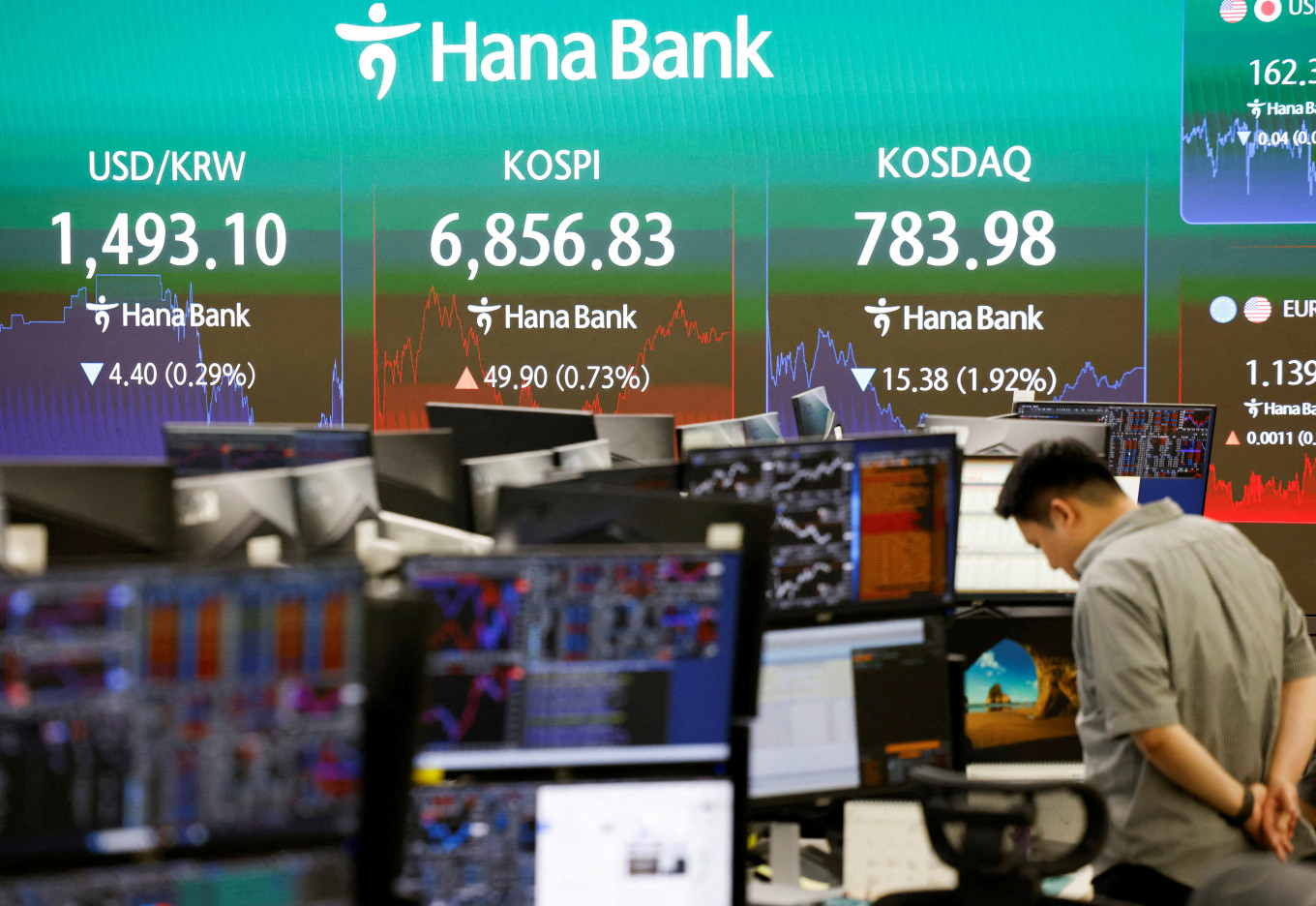 A currency dealer works as an electronic board displays the Korea Composite Stock Price Index (KOSPI), the exchange rate between the US dollar and South Korean won and the Korea Securities Dealers Automated Quotations (KOSDAQ) at the dealing room of a bank in Seoul on July 14, 2026. (Reuters/Kim Soo-hyeon)
A
sian stocks rose on Friday, poised for their strongest week in two months as benign inflation data dented expectations of an imminent US rate hike, although faltering talks to end the war in the Middle East are likely to keep risk sentiment in check.
Brent futures steadied at $87.03 per barrel after a drop on Thursday but were set for a 4 percent weekly gain, snapping a two-week losing streak, after the US threatened to ramp up economic pressure on Iran, including extending a naval blockade.
Markets have so far shrugged off the lack of progress in ending the Iran war, instead focusing on the broad AI theme and the global monetary policy outlook.
US inflation reports this week suggested pricing pressure remained under control, lowering the odds of a rate increase from the Federal Reserve next month.
Charu Chanana, chief investment strategist at Saxo, said risk appetite can hold for now because the immediate Fed hike risk has been repriced lower, noting softer oil is also helping.
"But this is still a headline-driven rally rather than a clean risk-on regime," said Chanana. "Without clarity on the Middle East/Hormuz, another oil spike could quickly revive inflation and Fed concerns."

In stocks, MSCI's broadest index of Asia-Pacific shares outside Japan rose 0.28 percent, heading for a 2.7 percent weekly gain, its strongest performance since mid-June. Japan's Nikkei was 1.5 percent higher, set for an over 5 percent gain for the week.
A puzzling feature of markets in recent months has been the growing disconnect between geopolitical uncertainty and asset price volatility, said John Sidawi, senior portfolio manager for fixed income at Federated Hermes.
"For now, markets appear willing to tolerate a significant amount of uncertainty without demanding higher risk premiums. However, this equilibrium is unlikely to be permanent," Sidawi said.
"A meaningful escalation in conflict or a clear path toward resolution could finally force investors off the sidelines, potentially triggering a much larger volatility response than current market pricing implies."
Yen stuck in intervention loop
The yen was at 159.40 per US dollar, hovering close to the crucial 160 level that traders believe could trigger another bout of yen buying from Tokyo, after a joint intervention with the US at the end of July failed to steady the frail currency.
Traders have since warmed to the idea that the Bank of Japan may at last start to support the yen, pricing in the prospect of a rate hike next month, although the risk now is that investors might come away from the September meeting disappointed if the BOJ is deemed not hawkish enough.
Padhraic Garvey, head of global rates and debt strategy at ING, said the yen's weakness comes from "an uber-cautious Bank of Japan and a policy rate that remains too low," noting the yen is back testing 160 levels as the underlying issues remain.
"This tension can be eased through rate hikes, and the sooner, the better," said Garvey. "While that could be construed as negative for the economy, it's also a choice. Prioritise the protection of the yen, or not?"
In commodities, gold was 0.8 percent down at $4,313 per ounce, as traders locked in profits after the yellow metal hit its highest level since early June in the previous session, due to dimming expectations of a near-term hike.
Traders are now pricing in a 35 percent chance of the Fed hiking next month, compared with 55 percent a week earlier, CME FedWatch tool showed. That led to a rally in US Treasuries although a lackluster US 30-year bond auction weighed.