The Jakarta Post
Please Update your browser
Your browser is out of date, and may not be compatible with our website. A list of the most popular web browsers can be found below.
Just click on the icons to get to the download page.


Popular Reads
Top Results
No results found. Please check your search term and try again
Can't find what you're looking for?
View all search results
Popular Reads
Top Results
No results found. Please check your search term and try again
Can't find what you're looking for?
View all search resultsStocks mixed as Seoul stabilizes, oil prices rise with eyes on Mideast
South Korea's Kospi swung between gains and losses, with chip giants SK hynix and Samsung, which have been the poster boys of a month-long AI-themed rout, center of attention again.
Change text size
Gift Premium Articles
to Anyone
Share the best of The Jakarta Post with friends, family, or colleagues. As a subscriber, you can gift 3 to 5 articles each month that anyone can read—no subscription needed!
 Set as preferred source
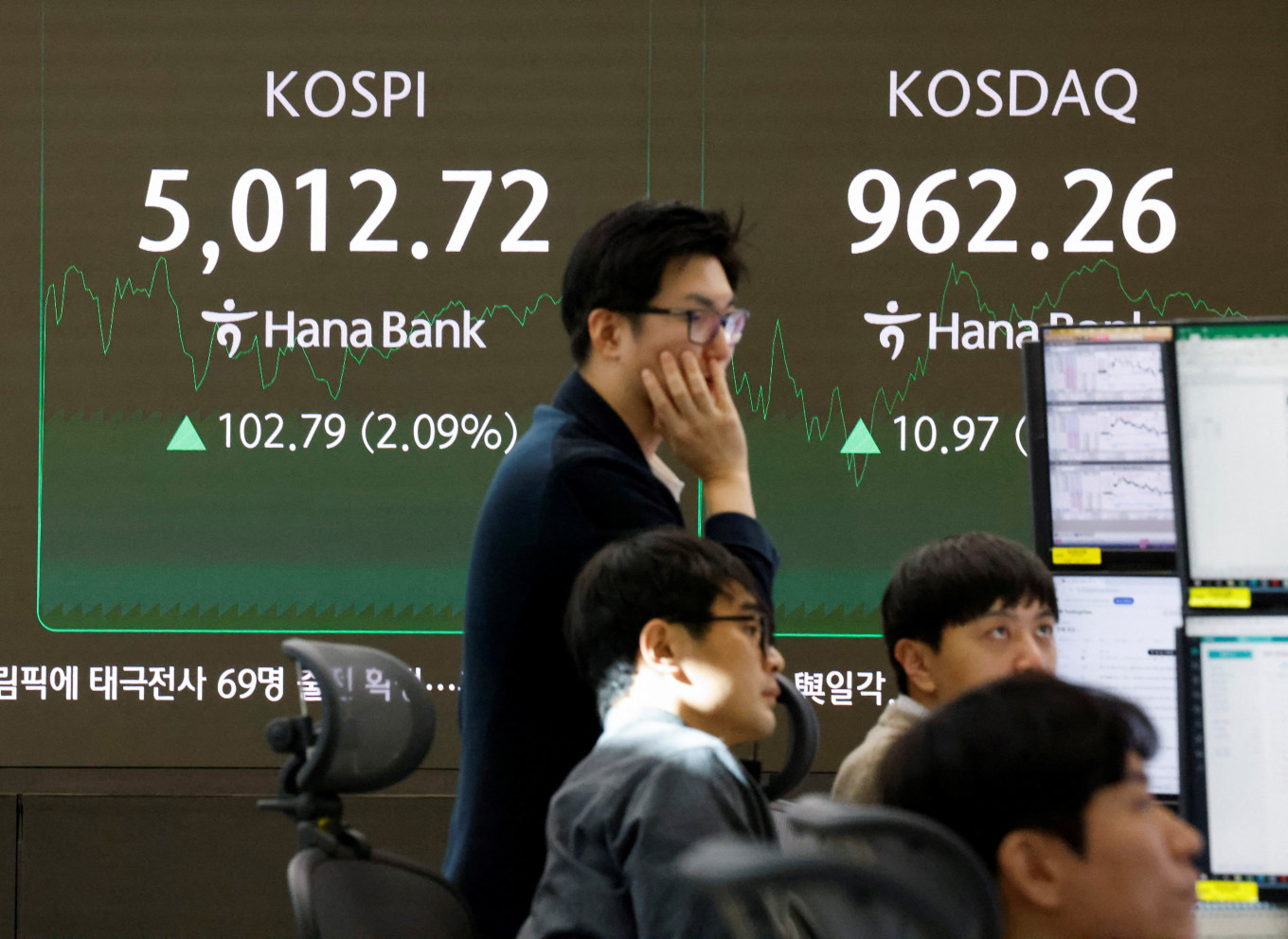 Currency dealers work in front of an electronic board displaying the Korea Composite Stock Price Index (KOSPI) over 5,000 points in the dealing room of a bank, in Seoul on Jan. 22, 2026. (Reuters/Kim Soo-hyeon)
S
tocks stabilized in Asia on Tuesday after last week's tech-led rollercoaster ride as investors tracked a record day on Wall Street, while oil prices edged up after their recent plunge with Donald Trump and Iran giving conflicting views on peace talks.
South Korea's Kospi swung between gains and losses, with chip giants SK hynix and Samsung, which have been the poster boys of a month-long AI-themed rout, center of attention again.
The gains followed a positive day in New York, where the Dow ended at an all-time high, helped by another impressive Amazon surge that pushed it past the US$3 trillion market capitalization and helped ease fears about the vast capital spending on artificial intelligence.
Seoul's stocks fluctuated through the morning. Last week the Kospi fell around 17 percent in three days before soaring nearly 18 percent Friday and falling again Monday.
Elsewhere, Sydney, Singapore, Wellington, Taipei, Jakarta and Manila rose, though Tokyo, Hong Kong and Shanghai dipped.
And after the past month's wild volatility, some analysts are more upbeat about the outlook, even as some continue to fret.

"Earnings remain supportive, investment in AI infrastructure is still firm and the US economy appears to be slowing at the margins rather than breaking beneath the surface," wrote SPI Asset Management's Stephen Innes.
"That does not guarantee an uninterrupted move higher, but it gives the rebound a more credible foundation than short covering alone."
Traders are now keeping an eye on earnings from SpaceX this week as well as the release of key US jobs data that could provide a fresh guide for the Federal Reserve as it plots its next move on interest rates.
Oil prices rose around one percent, having plunged five percent Monday, on hopes for a US-Iran deal to reopen the Strait of Hormuz.
US President Trump said Monday that negotiations were ongoing despite Tehran's denials.
"This is a last chance for them to sign a good document," he told reporters at the White House. "I want to give them every last chance before decapitation."
The talks are focused on reopening the crucial waterway, which Trump said could come "literally by tomorrow", and the denuclearization of Iran, which he said could "take a little while".
Iran's foreign ministry denied on Monday that negotiations with Washington were taking place, but Trump insisted they were. "We are talking right now," he said.
Tehran did say it was in talks with Oman to secure passage through the strait, through which a fifth of global oil and LNG pass.
Crude had tumbled Monday after the president backed away from a threatened strike on Iran that he said would have been "the biggest attack since World War II".
On currency markets the yen weakened against the dollar after Friday's rally sparked by a historic joint intervention by Japanese and US authorities, and their finance ministers pledged to support the unit again.
The Japanese unit strengthened from a four-decade low around 163 to the greenback Friday, to 155.23 Monday, its best level since May, before paring the gains.