The Jakarta Post
Please Update your browser
Your browser is out of date, and may not be compatible with our website. A list of the most popular web browsers can be found below.
Just click on the icons to get to the download page.


Popular Reads
Top Results
No results found. Please check your search term and try again
Can't find what you're looking for?
View all search results
Popular Reads
Top Results
No results found. Please check your search term and try again
Can't find what you're looking for?
View all search resultsFrom lottery draws to fiscal spending, China broadens digital yuan footprint
Change text size
Gift Premium Articles
to Anyone
Share the best of The Jakarta Post with friends, family, or colleagues. As a subscriber, you can gift 3 to 5 articles each month that anyone can read—no subscription needed!
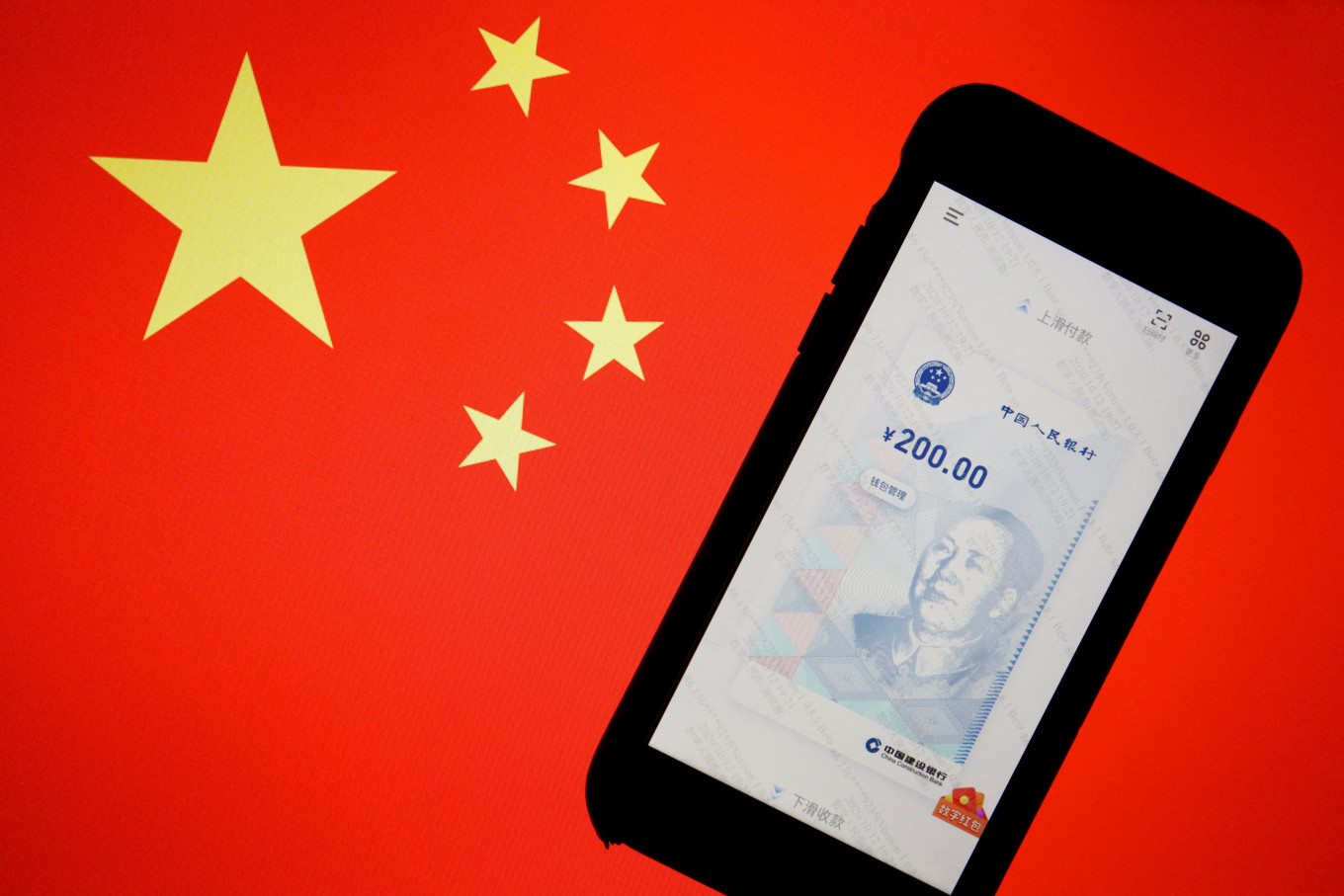 China's official app for digital yuan is seen on a mobile phone placed in front of an image of the Chinese flag, in this illustration picture taken on Oct. 16, 2020. (Reuters/Florence Lo)
C
hina's central bank is making a broad push to increase the use of digital yuan at home and abroad, several industry sources said, setting Beijing on a different – and potentially competing – path from the United States in shaping the future of money.
In a series of measures, many revealed here for the first time, the People's Bank of China (PBOC) is giving banks policy incentives and behind-the-scenes directives to expand the use of digital yuan, also known as e-CNY, in areas ranging from lottery draws to green electricity charges and fiscal spending.
Banks are also being pressed to grow digital yuan use in cross-border transactions, particularly along Belt and Road Initiative routes, with lenders racing to develop compatible products including loans, letters of credit and bills, the sources said.
All the sources declined to be named as they were not authorized to speak to the media.
The PBOC did not respond to Reuters' request for comment.
China's bet on the digital yuan is in stark contrast with the US, where President Donald Trump has embraced stablecoins while banning domestic circulation of central bank digital currencies.

Some of the industry sources said Beijing's move is partly driven by a desire to reduce its dependence on a global payments system dominated by Western institutions and anchored to the dollar as the world's reserve currency.
The digital yuan serves as a technological backstop, helping ensure China's international trade flows continue uninterrupted during future geopolitical shocks, a concern underscored by external instability linked to the Middle East war, one of the industry sources said.
"The war has exposed the risks of dollar weaponization, highlighting the urgent need for de-dollarization among Middle East oil producers," brokerage China Securities Co wrote in a report, saying the Iran conflict is accelerating yuan internationalization.
As a result, the yuan's global influence could expand "from trade into the realm of geopolitics," it wrote.
Small base, big ambitions
To be sure, the digital yuan is starting from a low base and faces structural limits on how far it can expand.
Cumulative digital yuan transactions had reached 16.7 trillion yuan (US$2.47 trillion) as of November since its 2019 debut, according to the latest official data, compared with 279 trillion yuan in China's UnionPay card transactions in 2025 alone.
In cross-border digital payment, "China and the US are the two engines for the global economy and they're both pushing their own standards," said Xin Yan, CEO of Sign, which builds digital infrastructure for governments and institutions.
China's digital yuan is more compatible with the banking system but "it is not friendly for foreigners," Xin added.
The latest push gained momentum after China earlier this year began allowing interest payments on digital yuan holdings in a major policy shift. In April, authorities more than doubled the number of authorized operating banks to 22.
The move effectively turns the digital yuan into an on-balance sheet deposit liability for banks, significantly boosting their incentive to promote adoption as it counts toward deposit assessment targets and enables development of more credit and wealth management products, industry sources and analysts said.
A fintech industry insider who provides IT services to banks said that although progress had been slow in recent years, the Chinese government appears "serious this time" about driving broader adoption of the digital currency.
Lottery draw, fiscal irrigation
Digital yuan deposit balances and account numbers are now key metrics in how banks are evaluated, the person said, adding that the goal is to build critical mass and an ecosystem that pulls in broader participation.
To boost domestic usage, the PBOC is testing applications using "smart contracts" - embedded programs that trigger automatic payments when predefined conditions are met.
Pilots include lottery draws, prepaid cards, government fiscal spending and supply chain financing, the industry sources said.
Authorities are also testing the digital yuan to curb medical insurance fraud and track green electricity consumption, leveraging its ability to trace money flows with precision, said the sources.
Local governments have set numerical adoption targets and are piloting internal use cases including salary payments and healthcare disbursements, one person at a payment company said.
The PBOC is also considering establishing a clearinghouse similar to China UnionPay to process digital yuan transactions among all operating banks and improve efficiency, sources said. These uses have not been previously reported.
Cross-border hurdles
The digital yuan is unlikely to disrupt retail payment behavior dominated by Alipay and WeChat Pay, with its ultimate purpose focused on international settlement between enterprises, the industry sources said. However, expanding abroad poses even greater challenges.
Zhou Xiaoquan, an official at Shanghai's Financial Commission Office, said the city is encouraging institutions to adopt mBridge, a central bank-backed platform linking China, Hong Kong, Thailand, the United Arab Emirates and Saudi Arabia.
He noted at a conference last month that related business applications already span trade in goods and services as well as shipping insurance.
Cross-border payments with ASEAN countries are a major priority, one of the industry sources briefed on the regulators’ thinking said, though a key obstacle is that overseas counterparties have shown limited enthusiasm for adopting the digital yuan.
For yuan internationalization to get traction, overseas counterparties must be willing to use it, the source said, cautioning that it is still "a long road ahead."