The Jakarta Post
Please Update your browser
Your browser is out of date, and may not be compatible with our website. A list of the most popular web browsers can be found below.
Just click on the icons to get to the download page.


Popular Reads
Top Results
No results found. Please check your search term and try again
Can't find what you're looking for?
View all search results
Popular Reads
Top Results
No results found. Please check your search term and try again
Can't find what you're looking for?
View all search resultsIndonesia advocates for interconnected systems in cross-border royalty management
Change text size
Gift Premium Articles
to Anyone
Share the best of The Jakarta Post with friends, family, or colleagues. As a subscriber, you can gift 3 to 5 articles each month that anyone can read—no subscription needed!
 Set as preferred source
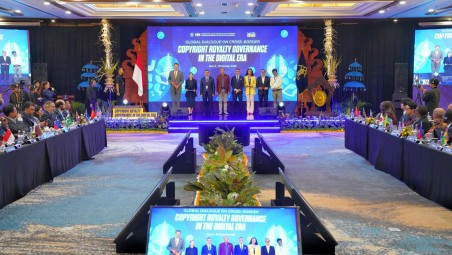 Global Dialogue on Cross-Border Copyright Royalty Governance in the Digital Era. (Image courtesy of the Law Ministry’s Directorate General of Intellectual Property)
I
ndonesia is advocating for the strengthening of cross-border copyright royalty governance to ensure greater transparency and accountability, supported by interconnected systems. These efforts are essential to guarantee that creators receive fair compensation when their works are used and generate economic value across different countries.
Deputy Law Minister Edward Omar Sharif Hiariej said Indonesia is seeking the support and leadership of the World Intellectual Property Organization (WIPO) to bolster cross-border royalty governance. Technological advancements, he said, allow creative works to cross national borders in seconds, whereas protection and royalty payment mechanisms have not kept pace with this speed.
“Creative works can cross national borders in seconds. Our cooperation to protect the people behind these works must be equally robust and seamless,” Edward said during the closing ceremony of the Global Dialogue on Cross-Border Copyright Royalty Governance in the Digital Era in Bali on Oct. 8.
The two-day dialogue yielded a number of observations regarding key issues in cross-border royalty governance.
Hermansyah Siregar, the Law Ministry’s director general of intellectual property, said the greatest challenge lies not in differences regarding substantive rights, but in incomplete or conflicting data.
In discussions on transparency, participants highlighted the limited access rights holders have to information regarding the usage of works, applicable deductions and the methods used to calculate royalty payments. Inaccurate metadata and the misuse of identification codes were also identified as issues.
Participants found that holding rights does not always result in creators receiving royalties. Missing contracts, identification code errors, and disconnected systems can disrupt the royalty management chain from the work's creation through to payment.
These issues become increasingly critical when works are utilized via global digital platforms.
Michel Allain of WIPO’s copyright management division acknowledged that negotiating licenses and royalties with major companies like Google and Apple is no easy task. "The market is global, so the solution must be global as well," he said.
Allain highlighted WIPO Connect as part of the infrastructure to improve data exchange. The system is available free of charge to developing nations, although the necessary infrastructure, such as servers and cloud capabilities, must be provided by the respective countries or collective management organizations.
Indonesia is advocating for a royalty governance framework that does not rely solely on contractual relationships between industry players. The government has proposed establishing global parameters to serve as a common reference point for determining royalty value trends.
This proposal will be pursued through WIPO’s Standing Committee on Copyright and Related Rights (SCCR). The next session is scheduled to take place in late November or early December.
Hermansyah stated that the Bali dialogue demonstrated how transparency, accountability and interoperability are mutually reinforcing elements. Interoperability does not imply that all countries must use the same system, but that different systems must be capable of communicating with one another through shared standards.
"We are prepared to continue more technical discussions with all interested partners in an open and inclusive manner," he concluded.