The Jakarta Post
Please Update your browser
Your browser is out of date, and may not be compatible with our website. A list of the most popular web browsers can be found below.
Just click on the icons to get to the download page.


Popular Reads
Top Results
No results found. Please check your search term and try again
Can't find what you're looking for?
View all search results
Popular Reads
Top Results
No results found. Please check your search term and try again
Can't find what you're looking for?
View all search resultsUNJ develops 3C method to stimulate cognitive activity among seniors at RPTRA Kayu Mas
Change text size
Gift Premium Articles
to Anyone
Share the best of The Jakarta Post with friends, family, or colleagues. As a subscriber, you can gift 3 to 5 articles each month that anyone can read—no subscription needed!
 Set as preferred source
 (Courtesy of The State University of Jakarta (UNJ))
T
he State University of Jakarta (UNJ) has developed a creative approach to stimulating memory while strengthening social interaction among the elderly, centered around writing, doodling and sharing their experiences.
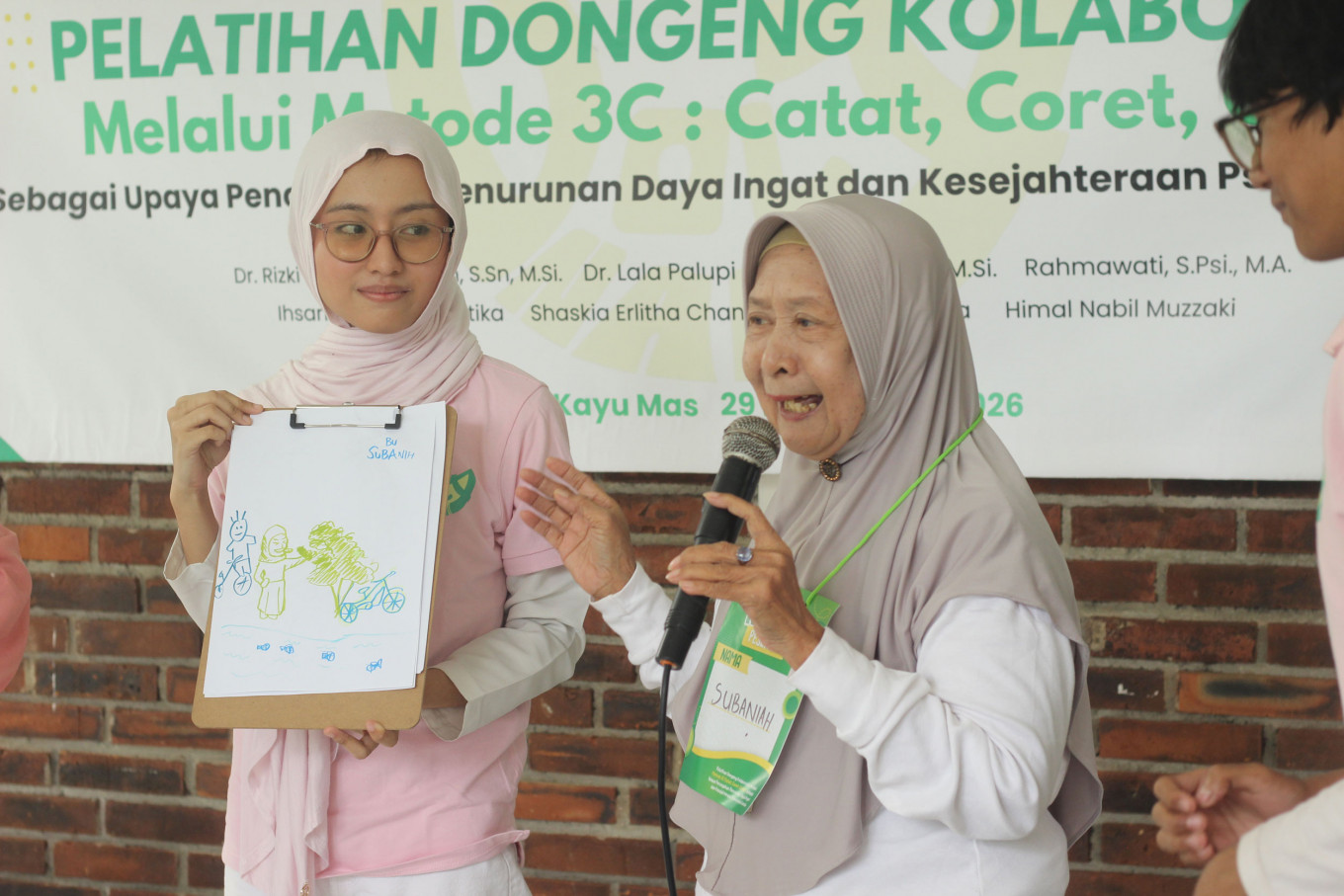
The 3C method, which stands for catat (record), coret (doodle) and cerita (tell), was introduced to a group of senior citizens participating at the Sekolah Senior Pintar (Smart Senior School) at RPTRA Kayu Mas in East Jakarta.
The initiative, led by Dr. Rizki Taufik Rakhman. as part of UNJ’s community service program, aims to provide activities for seniors that are informative, creative, participatory and grounded in lived experiences. The program is also funded for 2026 by the Directorate of Research and Community Service, Directorate General of Research and Development at the Higher Education, Science and Technology Ministry.
In the catat stage, participants are encouraged to write down keywords, experiences or memories. During the coret stage, they can make marks, draw simple images, or expand upon their notes in ways that suit their individual abilities and comfort levels. The final stage is cerita, where participants share these experiences verbally within small groups.
This process is designed to link cognitive activity with self-expression and social interaction, though the program is not intended to replace medical services or diagnoses.
The program’s description notes that “the life stories of the elderly are a vital part of this activity. They are not merely participants but also sources of experience to be shared and catalysts for interaction with others.”
To support the activities, the UNJ team developed the 3C–StoryCare Lansia pocketbook and Memory-Prompting Story Cards, which feature themes relevant to the lives of the elderly, such as family, work, childhood and past life events. The materials were designed in a non-digital format to ensure ease of use during group activities.
By utilizing participatory action research (PAR) and experiential learning approaches, participants are encouraged to engage in identifying needs, practicing writing and drawing, sharing stories and reflecting on the activities in which they participate.
The community service team also involves the management of RPTRA Kayu Mas and the administrators of Sekolah Senior Pintar, aiming to ensure that the introduced methods do not cease once the service program concludes but can instead be integrated into the Senior School's routine activities.
The program also engages university students as assistant facilitators. They assist with the process of supporting the elderly, documentation, collecting evaluation data, and conducting reflections with partners. Student involvement also serves as a form of contextual learning outside the campus environment.
In the long term, the team aims for RPTRA managers to be able to implement the 3C method independently. The program includes guidelines, learning materials, activity workflows and simple evaluation tools, enabling it to be replicated within Sekolah Lansia (Elderly School) programs.
Through this approach, RPTRA Kayu Mas serves not only as a public space for activities, but also as a venue where the elderly can reminisce, express themselves and listen to one another.
To learn more about the 3C program, visit @dolanan3.0 on Instagram or contact the team at [email protected]