The Jakarta Post
Please Update your browser
Your browser is out of date, and may not be compatible with our website. A list of the most popular web browsers can be found below.
Just click on the icons to get to the download page.


Popular Reads
Top Results
No results found. Please check your search term and try again
Can't find what you're looking for?
View all search results
Popular Reads
Top Results
No results found. Please check your search term and try again
Can't find what you're looking for?
View all search resultsExpert views Tri Hita Karana as a model for regenerative tourism
Change text size
Gift Premium Articles
to Anyone
Share the best of The Jakarta Post with friends, family, or colleagues. As a subscriber, you can gift 3 to 5 articles each month that anyone can read—no subscription needed!
 Set as preferred source
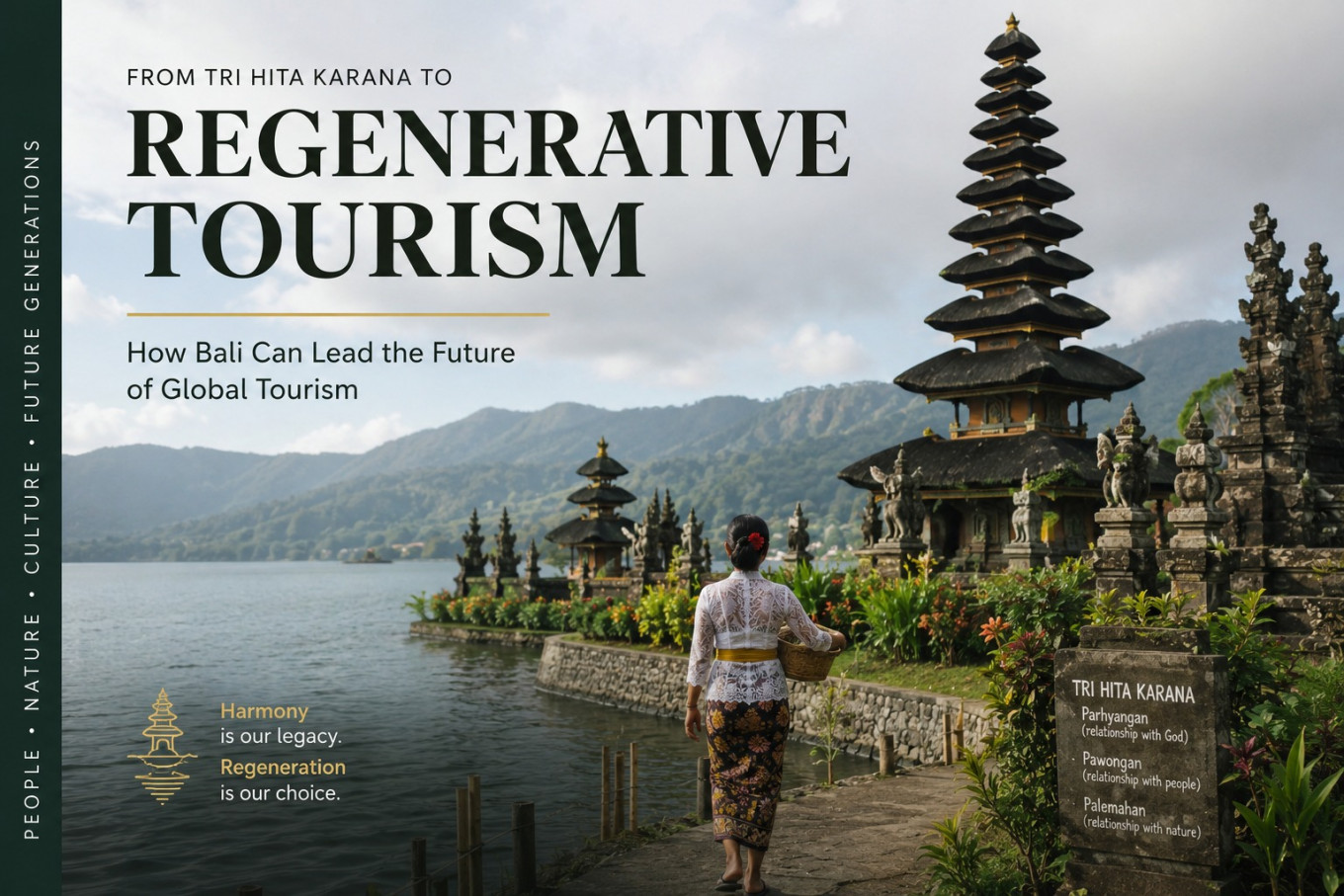 (Visual generated using Canva AI)
B
ali's Tri Hita Karana philosophy should be recognized as an indigenous model of regenerative tourism as the global tourism industry shifts beyond sustainability, according to tourism expert Dr. Putu Ayu Sita Laksmi of Warmadewa University.
"Today, scholars, policymakers and international organizations are increasingly embracing regenerative tourism, which seeks not only to sustain destinations but also to restore, enrich and regenerate them," she said.
She said Bali is among the few destinations that clearly illustrate this transition while also facing mounting pressures from rapid tourism growth.
"Congested tourist areas, mounting waste, pressure on water resources, land conversion and the commercialization of cultural practices have intensified debates over the long-term resilience of Bali's tourism industry," she said.
These challenges, she added, raise a fundamental question: should tourism success continue to be measured by visitor numbers and revenue, or by the positive legacy it leaves for local communities, ecosystems and future generations?
"Regenerative tourism encourages destinations to become healthier, ecosystems stronger, communities more prosperous and cultural traditions more resilient because of tourism—not despite it. Tourists are no longer merely consumers of experiences but active contributors to destination regeneration," she said.
Putu Ayu said this approach also aligns with Indonesia's ambition to develop quality tourism.
"Quality tourism is not simply about attracting high-spending visitors or luxury markets. It should emphasize meaningful interactions between visitors and local communities, equitable economic benefits, environmental responsibility and long-term cultural preservation," she said.
"The value of tourism should ultimately be assessed by the positive contribution it generates rather than by the number of arrivals it records."
According to Putu Ayu, although regenerative tourism has only recently gained global attention, Bali has long embraced many of its principles through Tri Hita Karana, which promotes harmony between humanity and God (parhyangan), among people (pawongan), and between humans and nature (palemahan).
While the philosophy has often been used as a cultural value or tourism branding element, she said its broader significance as a comprehensive tourism management framework has yet to receive sufficient international recognition.
"Rather than viewing Tri Hita Karana solely as a local philosophy, it should be recognized as an indigenous model of regenerative tourism," she said.
Its emphasis on reciprocal relationships, collective responsibility, environmental stewardship and social harmony closely reflects the principles now promoted by regenerative tourism scholars worldwide.
"In many respects, Bali has been practicing regenerative principles long before the concept itself became internationally recognized," she said.
She added that regenerative tourism places greater importance on quality than quantity, measuring success by environmental restoration, community well-being and cultural resilience rather than visitor arrivals or spending alone.
Putu Ayu also stressed that governments, tourism businesses, educational institutions, local communities and visitors all share responsibility for building a regenerative tourism ecosystem.
"By integrating Tri Hita Karana into tourism policies, business practices and academic research, Bali has the opportunity to contribute a new tourism paradigm to the world."